

The new DLR was cool, briefly.
A look at the DLR's B23 stock trains. Also, Essen.

tl;dr: The DLR’s new trains were great, apart from the train-end seats, but (for now) they’re past tense only.
Having enjoyed my day out on the Superloop a few weeks ago and been surprised at how the post that followed seemed to write itself, I’m going to try and do another storytelling post - this time on the day I caught one of the DLR’s new trains.
Back in September, TfL quietly introduced the first of the DLR’s long-awaited ‘B23’ trains on the last day of the month into passenger service, presumably in order to hit some sort of internal September 2025 or Q3 2025 deadline by the skin of their teeth.
The trains, built by CAF in Spain, were originally planned for introduction in 2024, and had been running around the network undergoing testing for many, many months.
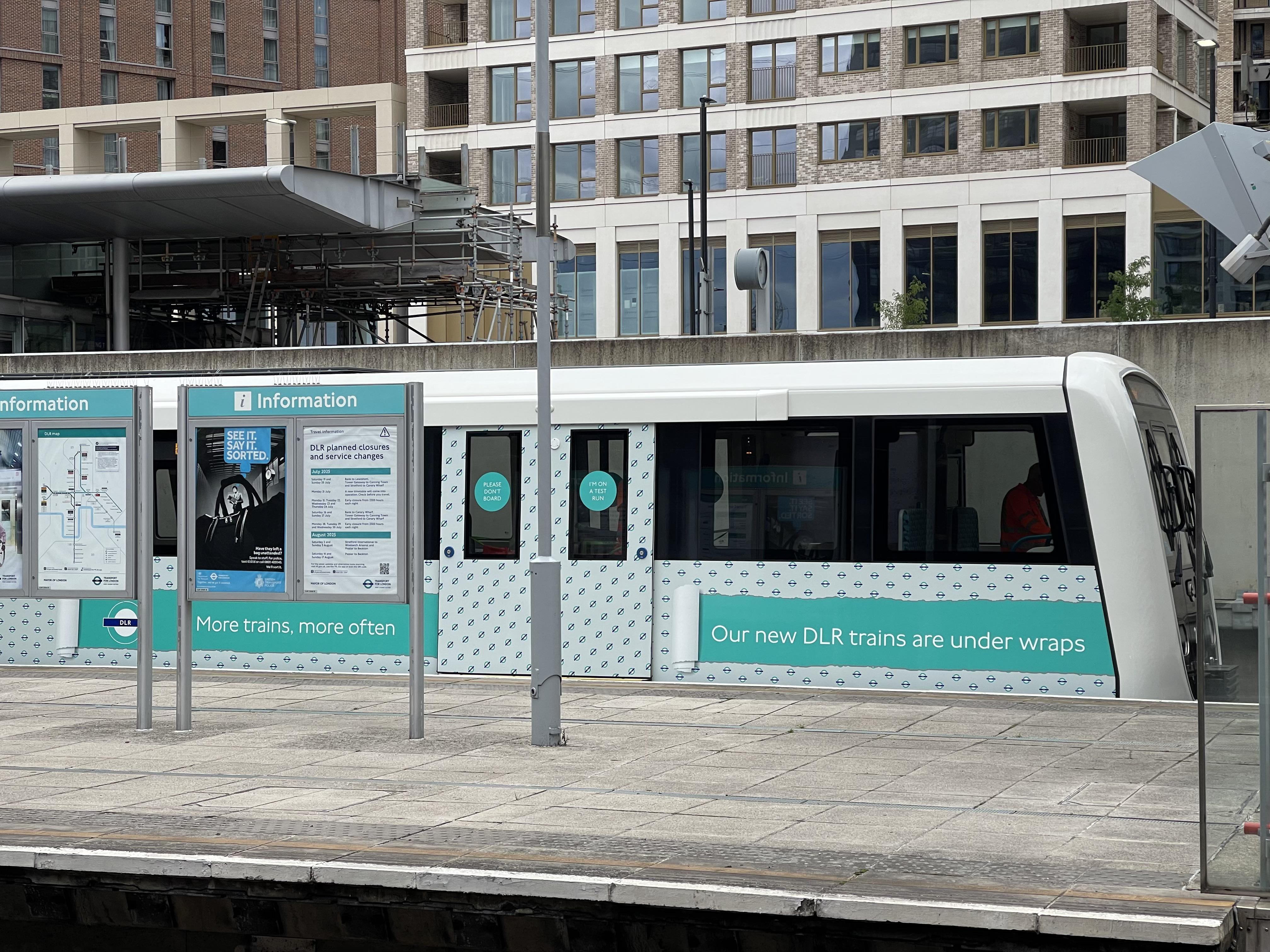
Seeing as the DLR comes within a few hundred metres from where I am most days, on 1st October (after TfL had done all their press and publicity in the morning with the Mayor, TfL big-wigs, the news and Geoff Marshall) I thought I’d go and hunt down the one train out there on the network - how hard could it be?
I started off at Stratford International, and got comfortable. After all, this could take a while - as there’s no way to tell where any particular train is on the DLR, and given what little information was known, the shiny new B23 plausibly could’ve been anywhere on the network.
On passing through Stratford on our way toward Woolwich Arsenal, a guy got on the train having a loud phone conversation, which alone was enough to make me hate his very being.
“I’m on my way to Canning Town, I’m on the hunt for the new DLR train!” he exclaimed with great enthusiasm. If there were ever a moment for that monkey-side-eye GIF, it was this. Whoever he was speaking to rightly questioned what on earth he was doing, and he repeated back “WHY?!” in outrage, leaving me chuckling to myself while looking out of the window on the other side and hoping he wouldn’t figure out I was on a similar expedition.
We headed along through West Ham passing one or two older trains in the opposite direction. There was a pretty good chance we’d pass the new train much like this and I’d have to go scrambling back to catch it somehow, so Canning Town was a sensible first place to camp out and wait for it.
At Star Lane, however, gold was struck. The new train pulled in heading the other way just as ours did, and on noticing this, both I and the guy (possibly others, further back) just so happened to realise that we were travelling in the complete wrong direction and crossed the platform. (Oh no, my cover’s blown!)
First impressions
My Twitter is very much the opposite of this blog in terms of how I articulate my thoughts so here is my initial reaction, eloquently put:

I really do have a way with words.
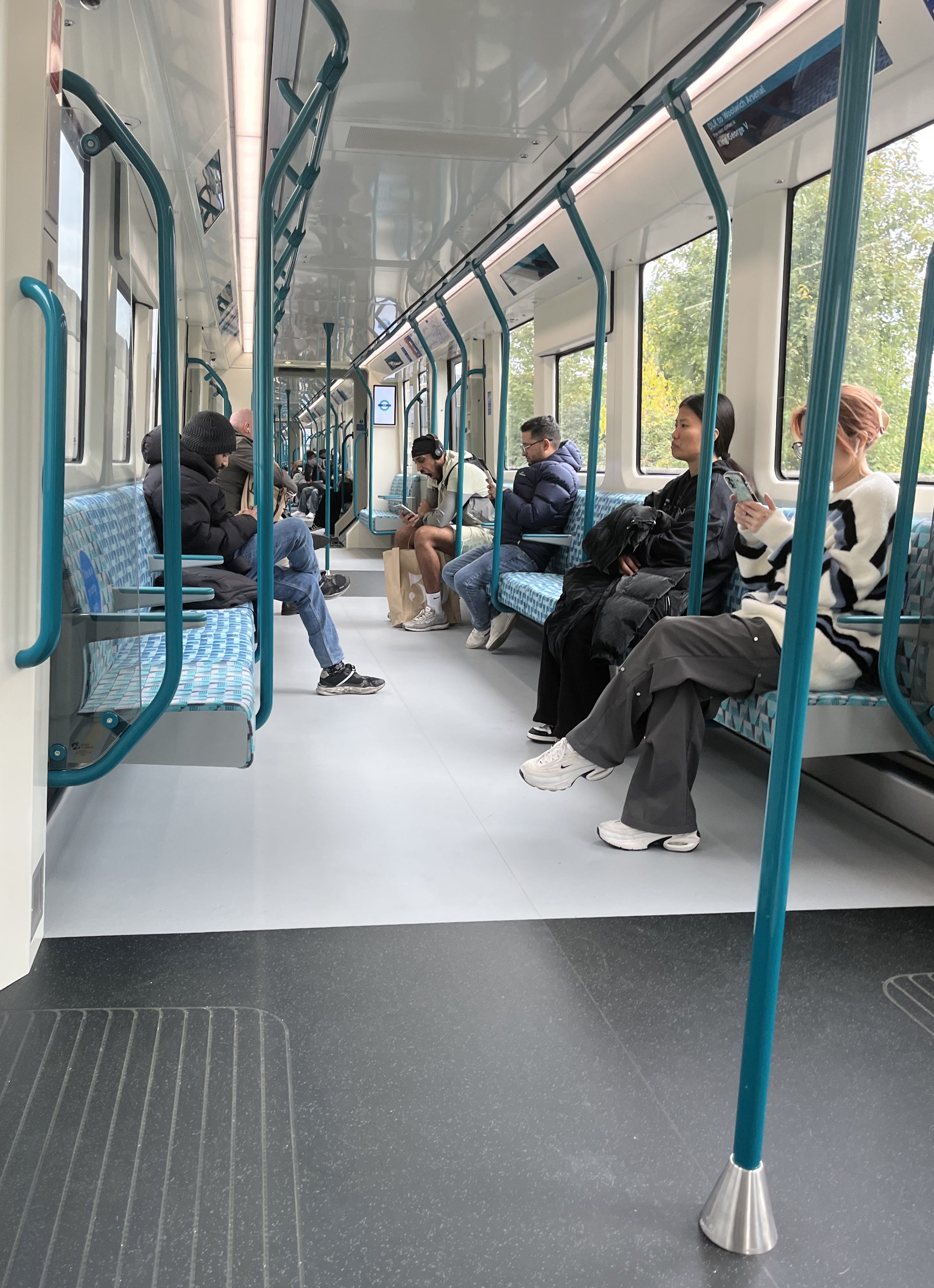
But seriously, the most striking thing about these new DLR trains is that they are long. Existing trains are made up of two-car units, which generally run in pairs of two, but most platforms can take three-unit trains, which only run on busier routes (when there are enough units to spare). These new trains are fixed at five cars in length, and just appear to go on forever thanks to being fully articulated and walk-through, so not having space taken up by car-ends and couplings.
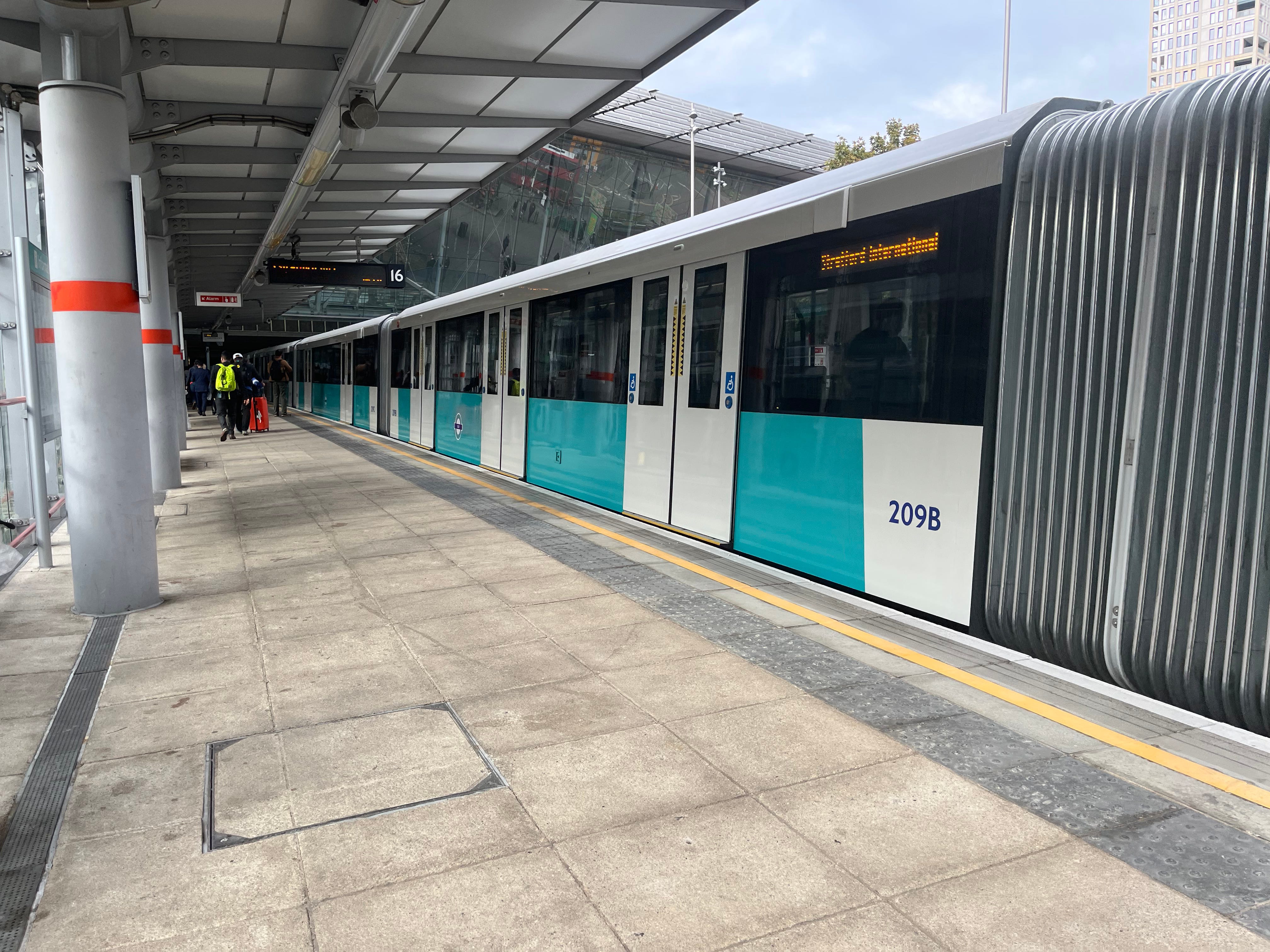
We headed back up toward the end of the line at Stratford International, alongside countless regular passengers who seemed oblivious that they were riding on a brand new train introduced only the day prior.
The second most notable thing was that this train was quiet - the older trains always gave the sense that they were struggling (but nonetheless determined) when going at full pelt through the tunnel under Westfield shopping centre, but this train not at all - just humming along and taking things in its stride.
At Stratford International, the train emptied out other than a handful of people who were clearly also there to take a look. This was my first chance to have a wander along the train and see how it was broken up, which turned out to be particularly different to the layout of all older DLR trains (these all more or less follow a similar layout) - the central carriage had a double wheelchair space, rather than having one in either unit of the train, for example.
The guy from before, having clocked what I was up to thanks to my totally-not-suspicious change of direction earlier, and the fact I was still there wandering around an empty train, pointed out that there was “a YouTuber” down at the end (he seemed very impressed by this) and I glanced along to see a guy recording bits for his channel and being shown the driving controls at the front of the train by the PSA.
The Essen connection
Before I talk about the new train too much, I thought I’d do the opposite and instead talk about the oldest. Way-back-when in 2015, a friend (far bigger a foamer than I could ever hope to be) made the proposal “I’m going to see the original DLR trains in Germany, do you want to come?”, and honestly, how could anyone refuse an offer like that? After all, who doesn’t love the DLR (and certainly who doesn’t love it enough to travel internationally for it)?
We travelled to Essen in Germany where the original DLR trains (P86 and P89 stock) from the late 80s could be found in use on their Stadtbahn (which has ‘U’ as a symbol, for reasons unbeknownst to me - it barely goes underground).
Once the tunnel to Bank opened during a period of rapid expansion on the DLR, these trains had to be retired due to not meeting fire safety requirements for running through tunnels (presumably not least due to the lack of train-end doors). They were sold and shipped off to Essen in the early 90s at just a few years old.
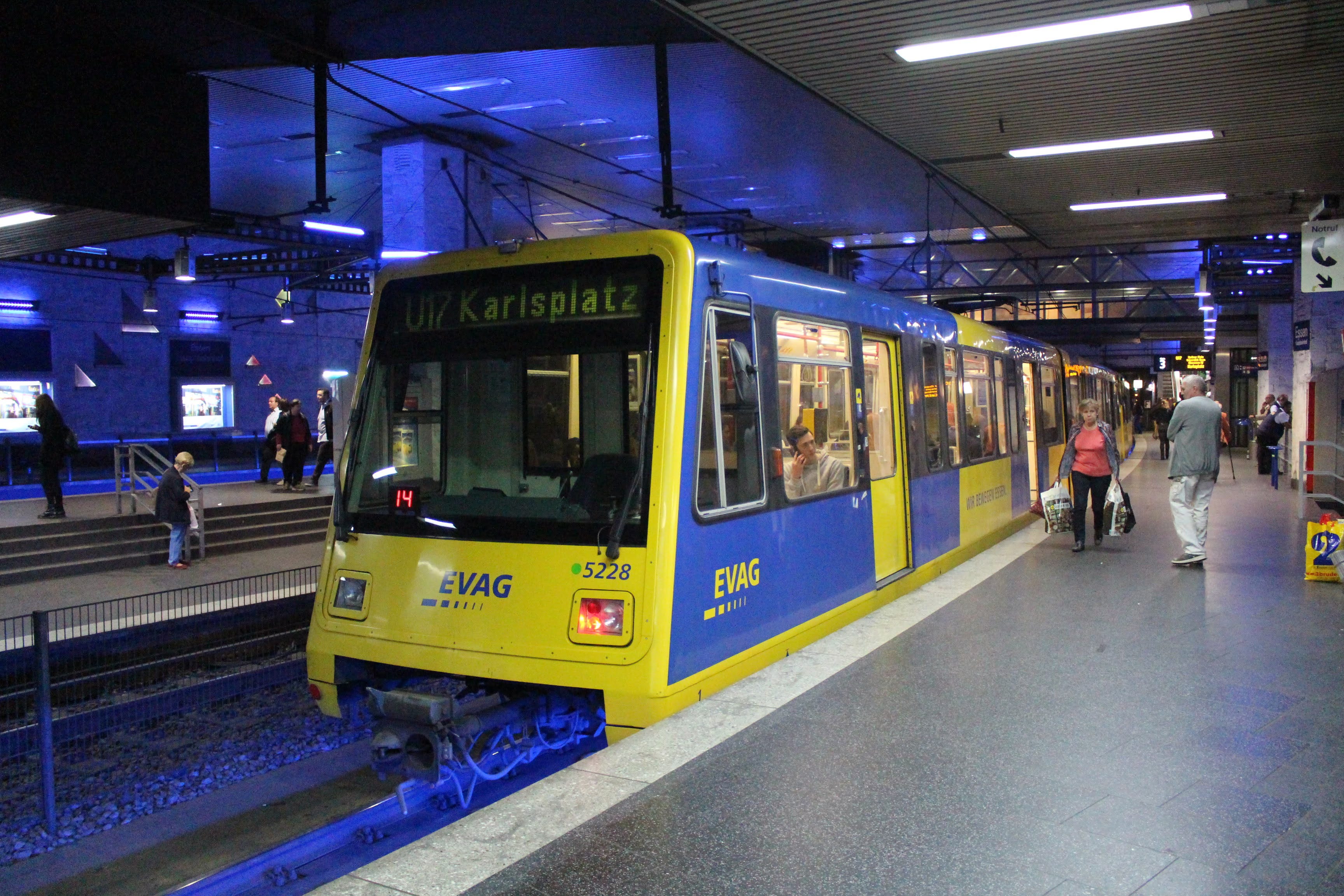
Even though they’d left the UK before I was born (and therefore I certainly hadn’t been on them), these trains unmistakably still had DLR in their DNA, even despite their having undergone conversion from automated operation to manual driving, and from third rail to overhead power. Here they were, at the time nearly twenty-five years out of London and honestly feeling like they could still be wobbling their way down the tracks from Stratford to Canary Wharf. If only it weren’t for the German announcements and weird ticket validator things and really genuinely unnerving way everyone seemed to want to have an impromptu staring contest with you…
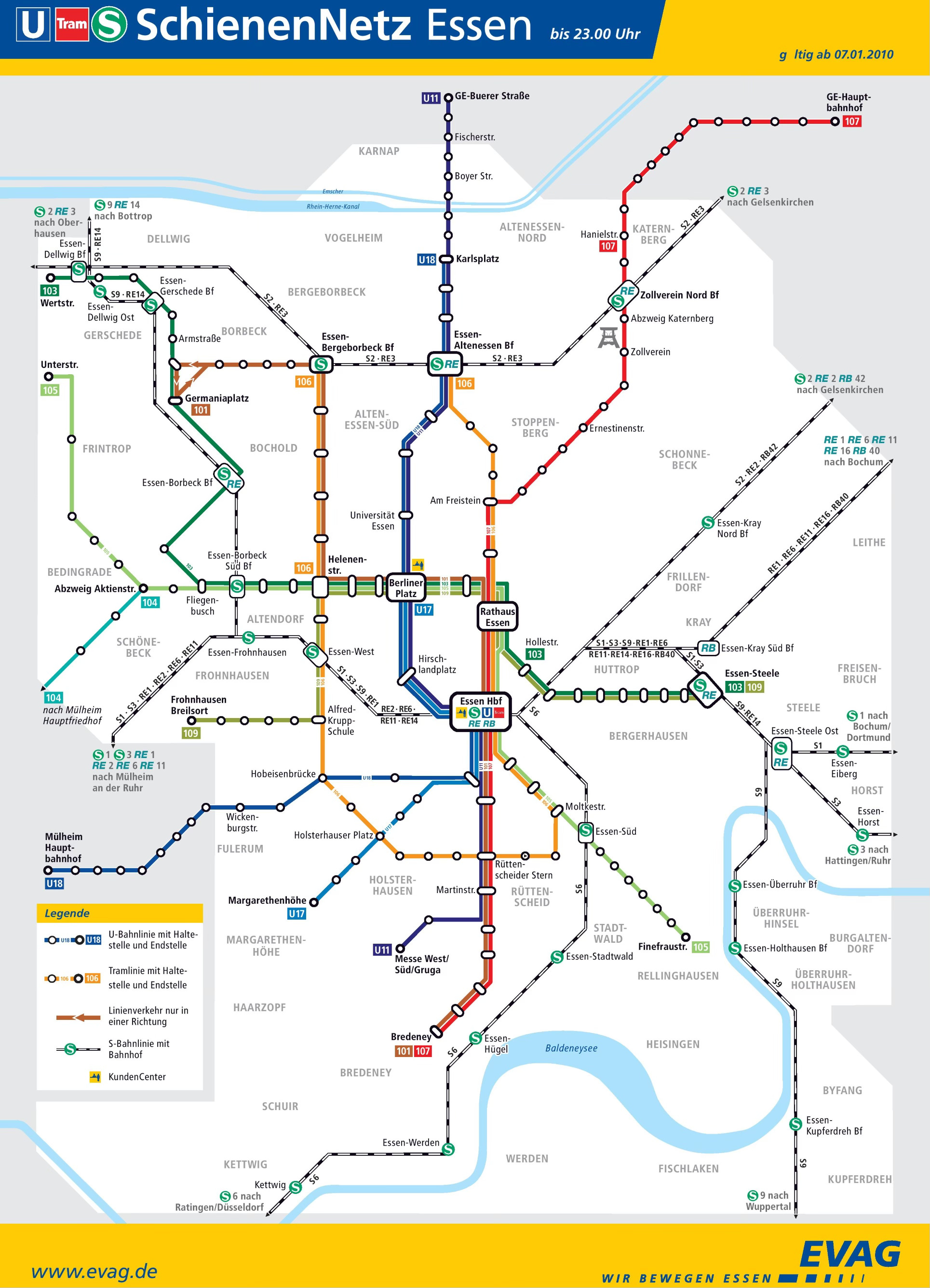
The Stadtbahn runs part in a dedicated right of way (some in a highway central reservation) and part on the street, and the whole network comes together in this underground cathedral of transport with cool blue lighting at Essen Hauptbahnhof. From what I can remember, we spent much of the time giggling like children at the name of the agency then running the town’s absurdly impressive transport network, which alongside the Stadtbahn included the Straßenbahn (trams) and a bus network. We also spent a day travelling to nearby Wuppertal to ride the unique Schwebebahn suspended railway, but I expect I could make that into its own post some day (if ever I can remember enough about it given how long ago it was).
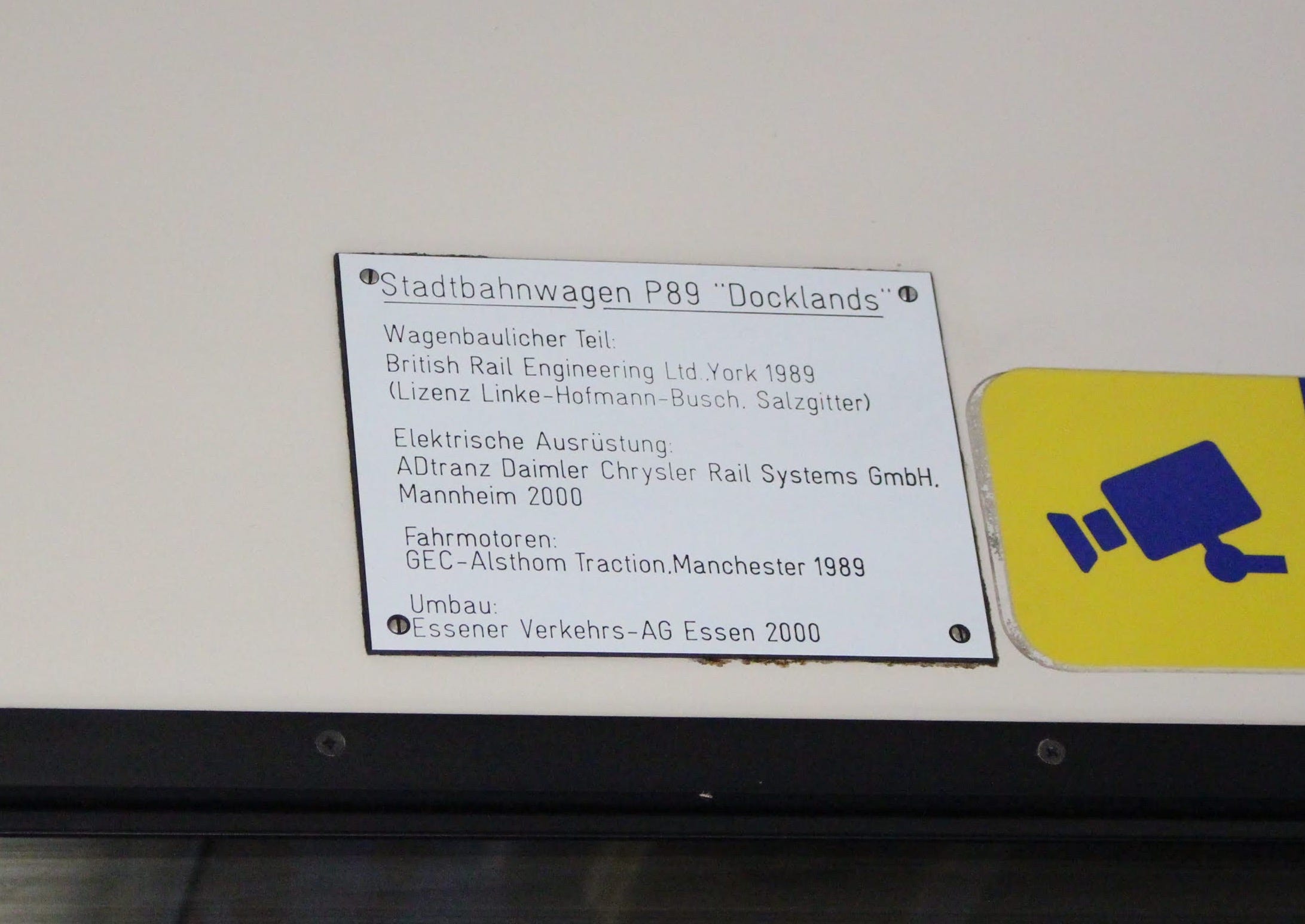
To this day, what I still find amazing is, these trains (or technically, some of them) were built by British Rail Engineering in York, ran around London’s Docklands for a couple of years, and then went on to spend the vast majority of their lives on the streets around a relatively-obscure industrious German city… what?!
I assumed they’d been scrapped by now, but no - the P86/89 trains, or rather stadtbahnwagen, are still running around in Essen approaching forty years old (albeit awaiting replacement), which is just the. coolest. thing.
But back to the present-ish day.
On leaving Stratford International I settled myself in one of the rearmost seats, facing out of the back of the train. These are such a disappointment compared with what they’re replacing - the old trains have always had huge, relatively unobscured windows and two rows of seats which give spectacular views particularly when heading through the heart of Canary Wharf (although frankly anywhere on the network).
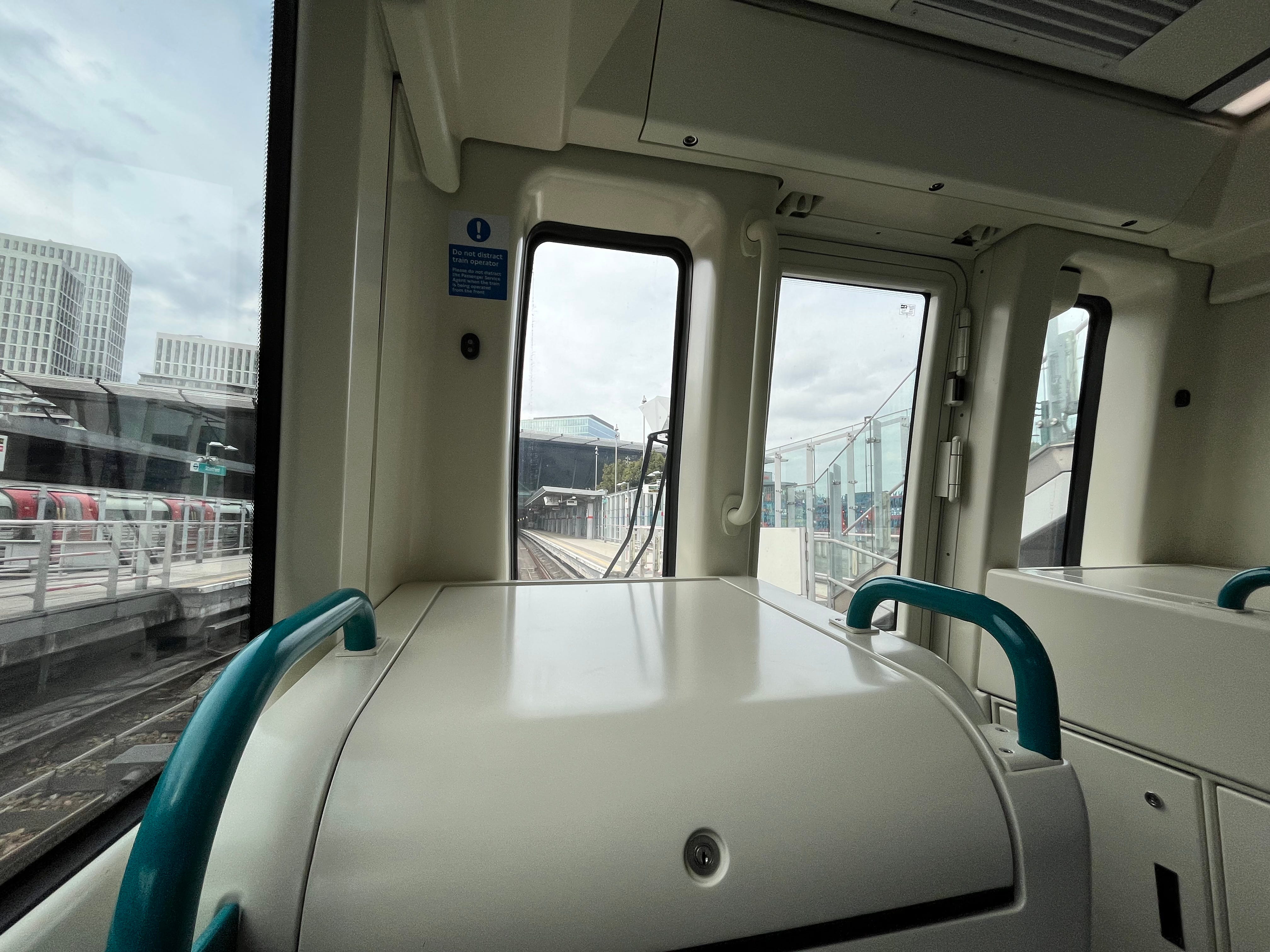
Unfortunately on these newer trains, the control consoles are tall and crazily deep, and the windows much smaller thanks to chunky frames - you feel like a toddler trying to drive a car but only being able to barely peek over the steering wheel. There’s also only a single row of seats right at each end, which don’t seem to be the full width of two seats as they had been in the past (presumably to allow as much clearance to the end door for evacuation purposes) and the entire end section felt claustrophobic and isolated from the rest of the passenger area thanks to a dividing screen. I’m not a fan.
The train headed down toward Canning Town where I was joined at the back by an elderly chap who was clearly also there to take a ride on the new train (given away by the pin badges on his blazer), but who had perched himself onto what remained of the seat-and-a-half that I was sitting on. Thanks to the presence of an armrest to hem us in, I had to abandon my foamer position at the next stop to avoid being crushed to death.
After Canning Town, the train navigated a rather complicated junction before heading up onto elevated tracks, where it showed off its improved acceleration on the climb. The train weaved through the southern part of the Docklands, passing City Airport, and after King George V, dove into the tunnel under the river before emerging at Woolwich Arsenal (which is not close to the start of the SL3 and I am definitely not bitter about this).
Here we had around 8 minutes before the train was due to head back up to Stratford.
One bizarre thing I noticed at Woolwich was the green lights which shone brightly over the doors when open - these honestly felt pretty excessive, and only stood out now given the lack of daylight in what was the first properly underground station we’d visited.


I have a feeling these are an accessibility feature and part of the standard design used by CAF for this family of train, but I can’t say I’ve ever seen anything quite like it before - there’s something very Halloween about their ominous glow.
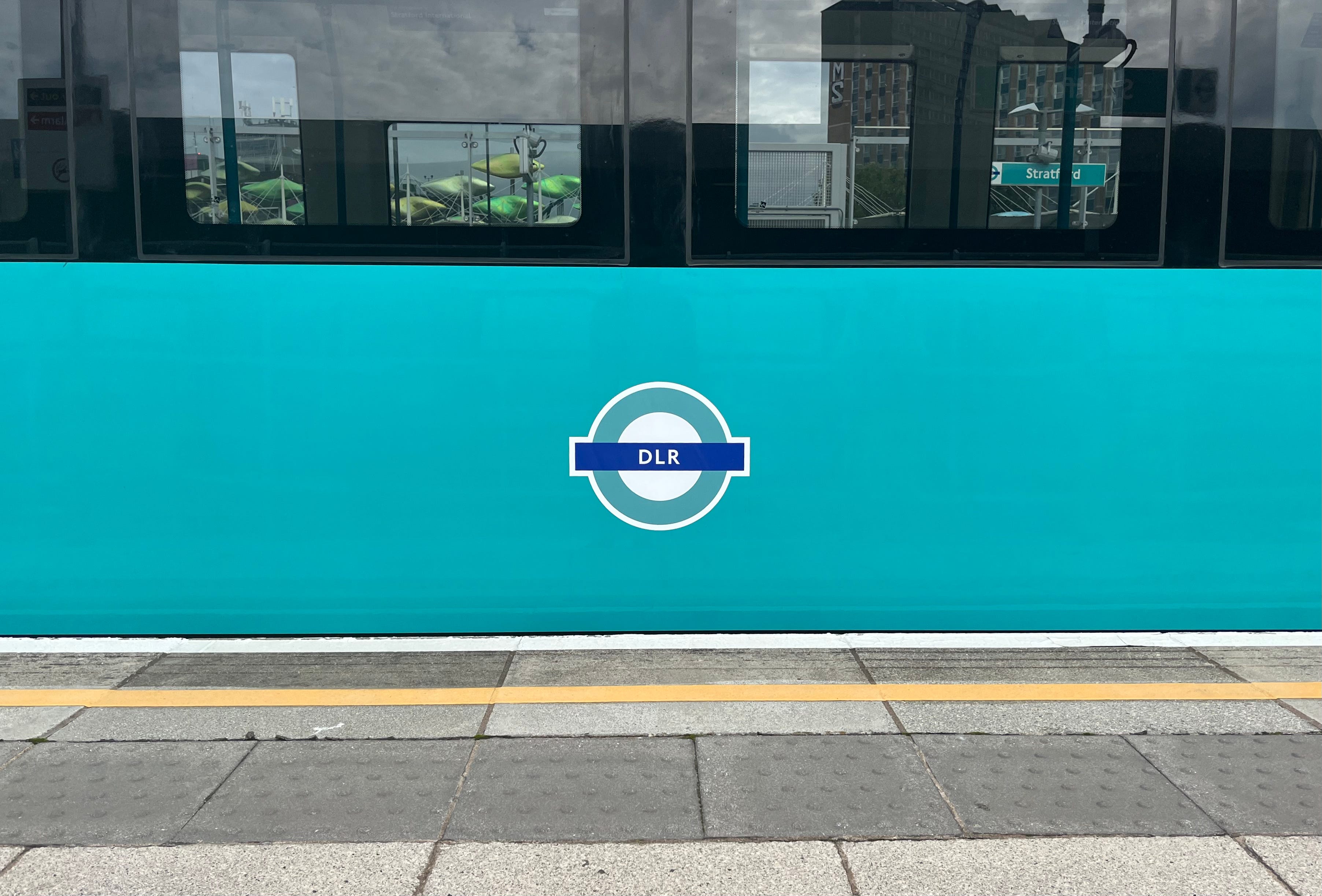
One big change for the DLR is the new livery - ditching the red-with-random-wavy-blue-swooshes thing for what can only be described as the turquoise equivalent of Barbie Pink - and it looks phenomenal:
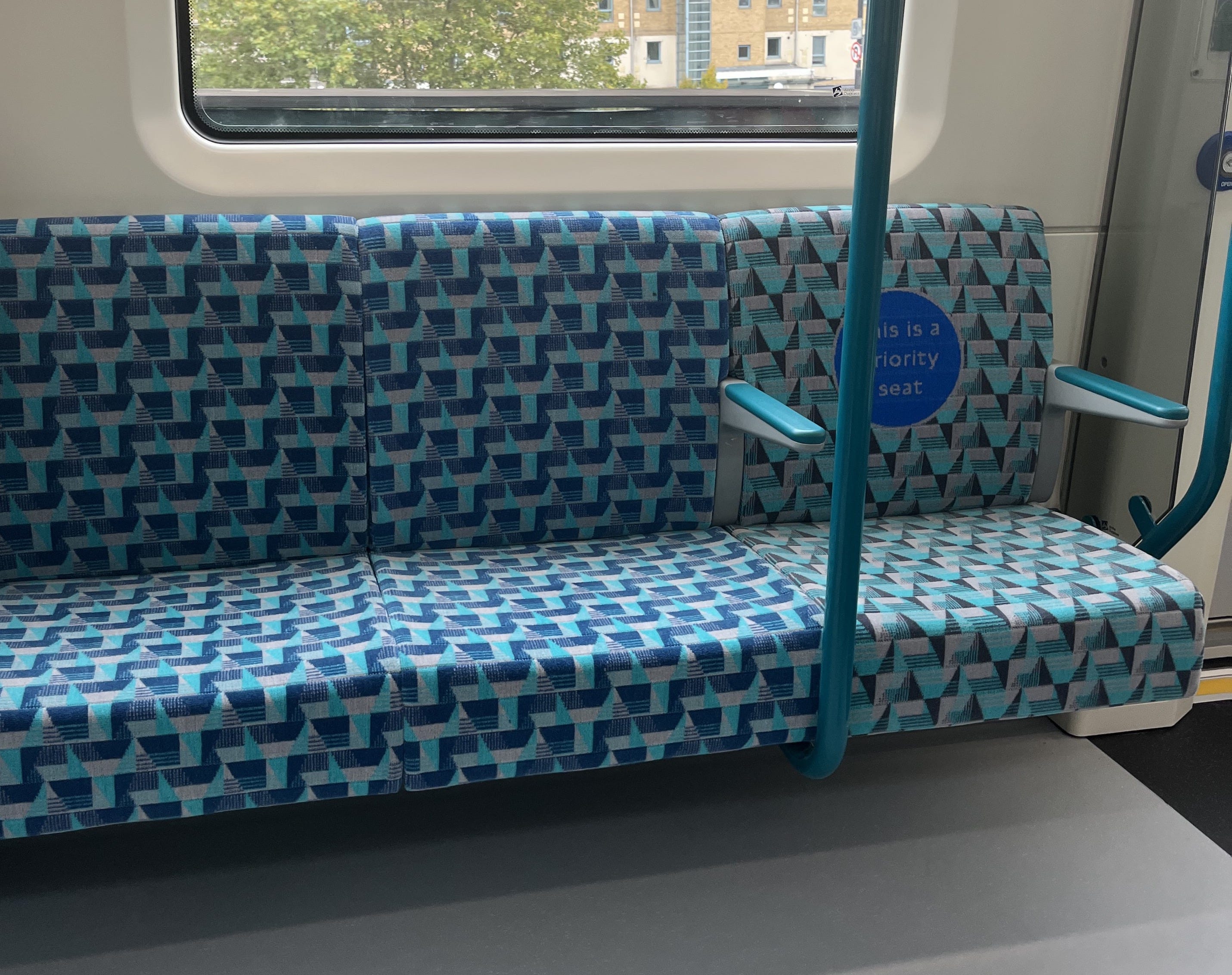
There’s also a new moquette, called Poplar, which replaces the existing blue-with-random-wavy-swooshes thing from the older trains (do you notice a trend?):
The train makes the same dings, bongs and other chimes that regular users of the DLR will be accustomed to hearing, but what surprised me most was that the depressing and monotonous robo-voice announcements used on older trains had also been retained. Given PSAs will presumably have to operate all the different train models used on the DLR, the former makes sense, but I was kinda hoping the announcements would be updated - TfL have been shifting to using Emma Hignett (of iBus fame) for lots of things, including the Elizabeth line and newer Overground trains, and so it would make sense to here her hear too.
Also, despite believing for years that the DLR voice was computer-generated, I was surprised to discover recently that it’s actually recorded by an actual bonafide real-life human being. I find this hard to believe, honestly - “This train. is for. Wull-ich-arrrrs-en-alll-vi-ah-Lunnn-dunnnn-ci-ty-aiiir-pooort.” Nobody says those words, with those intonations, in that cadence, localised entirely… even when their sentences are being stitched together. Ain’t no way, sorry.
After our brief layover at Woolwich Arsenal, we made our way back west, retracing our path through Silvertown along the south side of the Docklands.
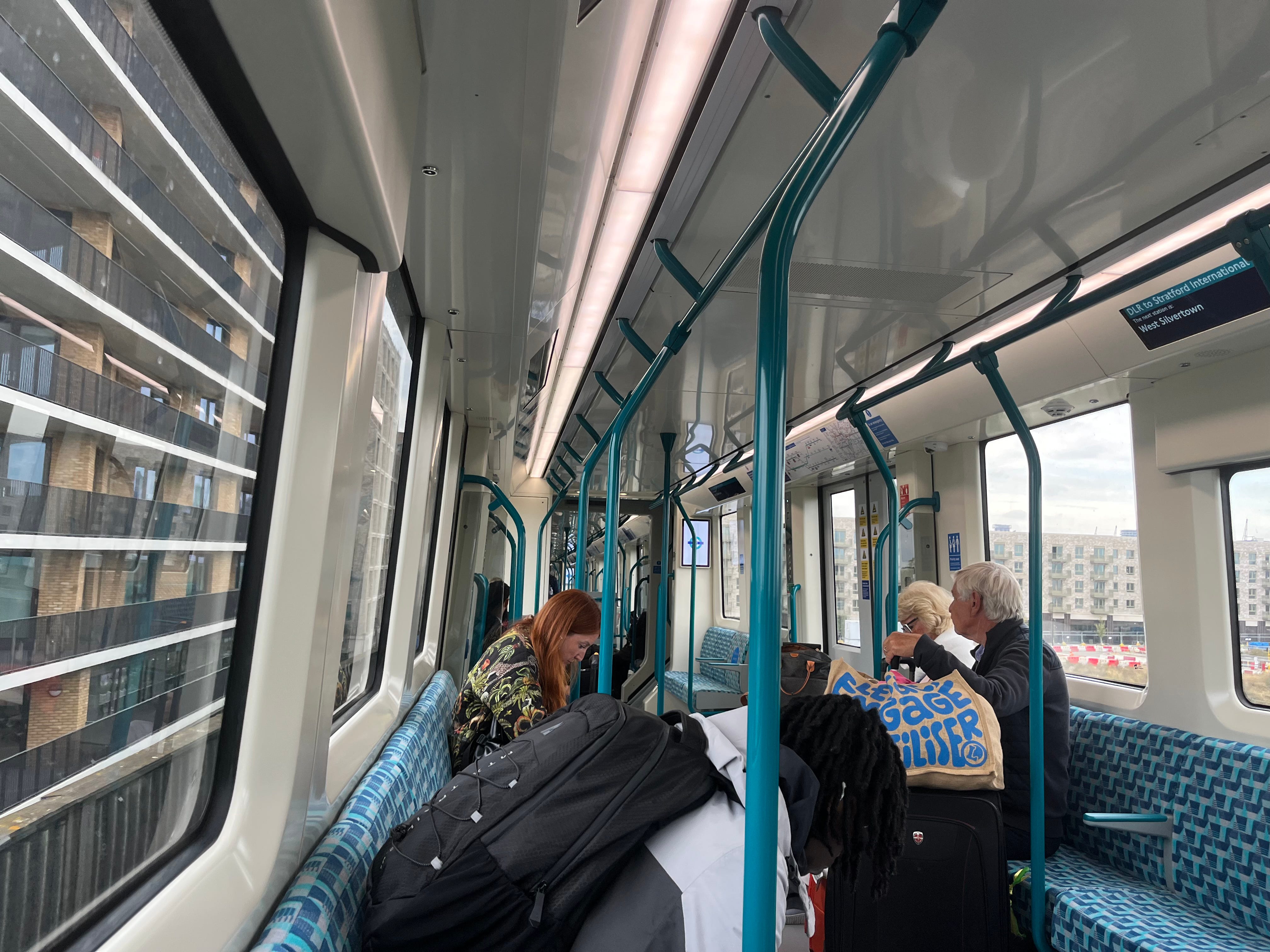
The important bit
Regular readers will be unsurprised to learn that most of the photos I have from the new train were of these fantastic passenger information screens. In fact, even the first photo I took was of one.
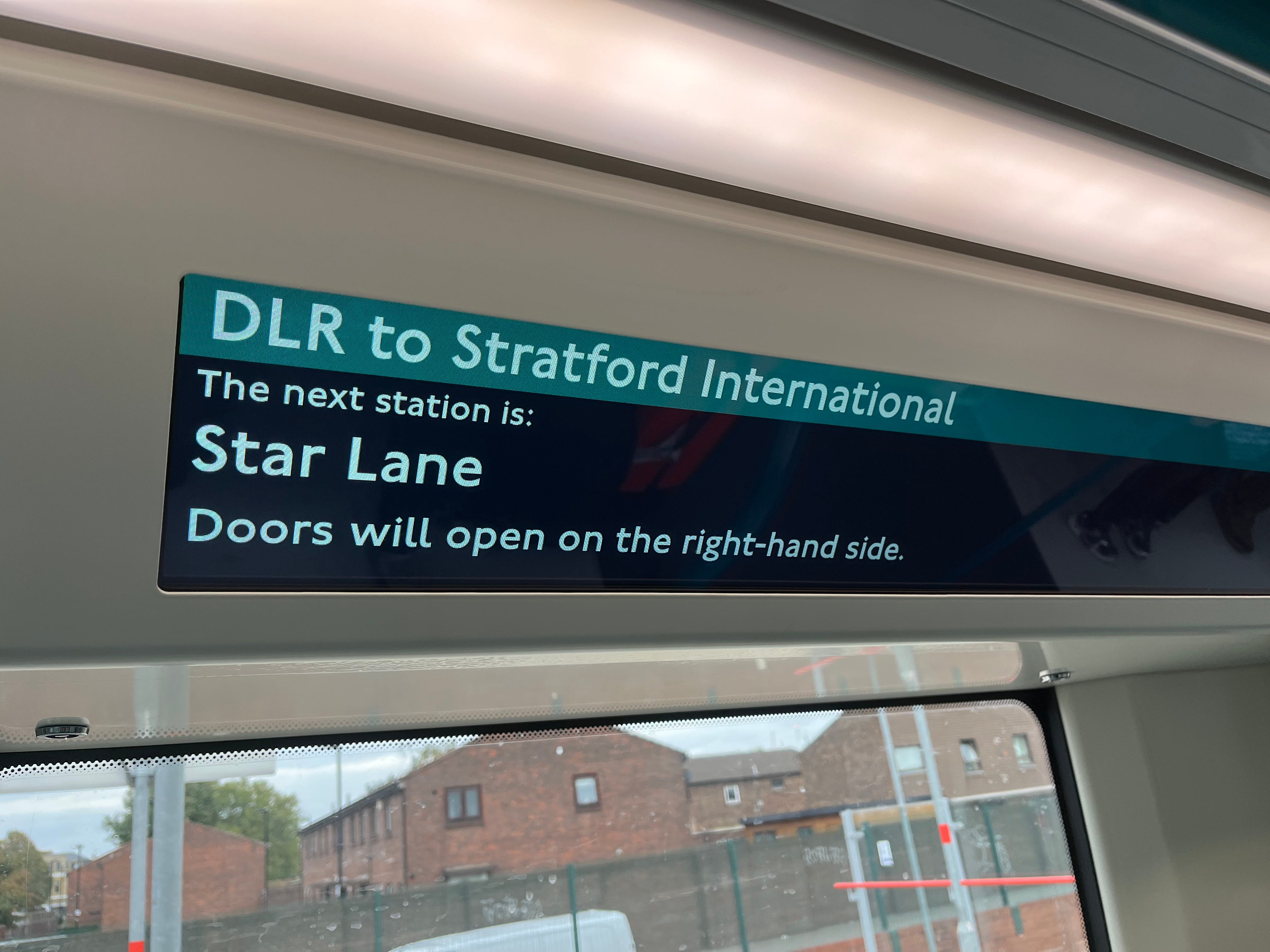
These are superb, possibly my favourite of any screens I’ve seen on a train or bus to date. Negative text colours, information prioritised sensibly, minimal use of DLR turquoise as an accent.
My only bugbears would be the use of a full-stop on the doors will open bit, and the colon preceding the station name, both of which I believe go against TfL’s style guides that prohibit unnecessary punctuation. (Oh, and, I thought the DLR had stops rather than stations…? Hmm!)
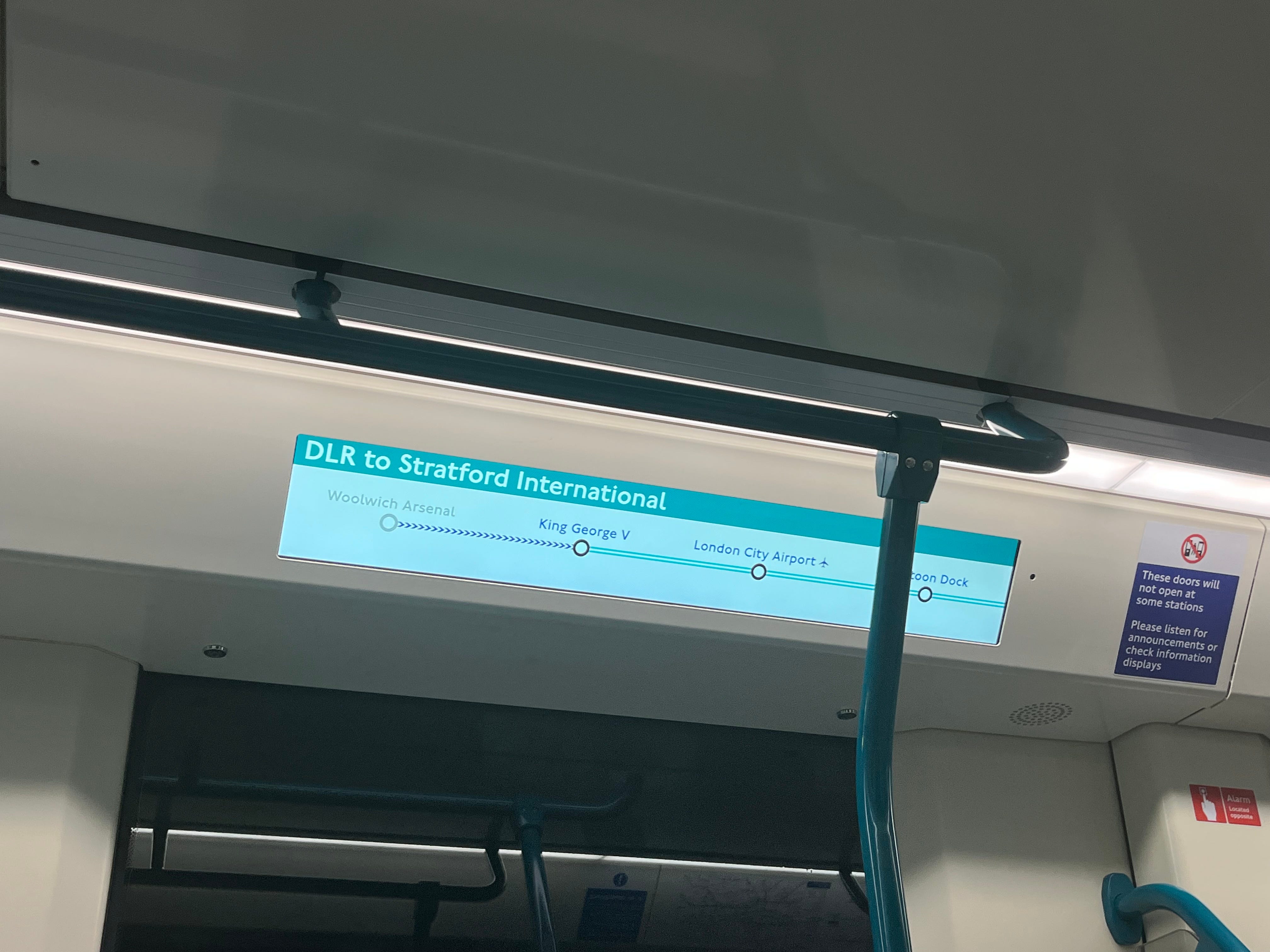
Even the line diagram pages were sensible, uncluttered, and it was great to see that the designers didn’t feel compelled to show the final destination of the train as part of them, something I absolutely despise (this often gives the false impression that the train will skip a bunch of stops and can be hard to parse) so much so that it may get its own post one day.

It seemed odd that there’s no ceiling mounted passenger information screens, given these are now on the sides, and I kept glancing up at the ceiling at where my brain expected them to be (as the LED screens on the old trains are), but I suppose that’s just force of habit.
Finally, I jumped off at Stratford so that at least I could have claim to have taken a journey to somewhere rather than ending up where I started. Unfortunately, because I didn’t leave the station at Woolwich, and therefore didn’t tap out and back in again, and because it all took a little bit too long, I paid a whopping £12.10 for this journey (which is two maximum fares for zone 2). Oops.
End
These new trains are excellent, and feel so much more substantial than anything that’s been clattering around the DLR up to now (which, as it turns out, I’m experienced enough to say).
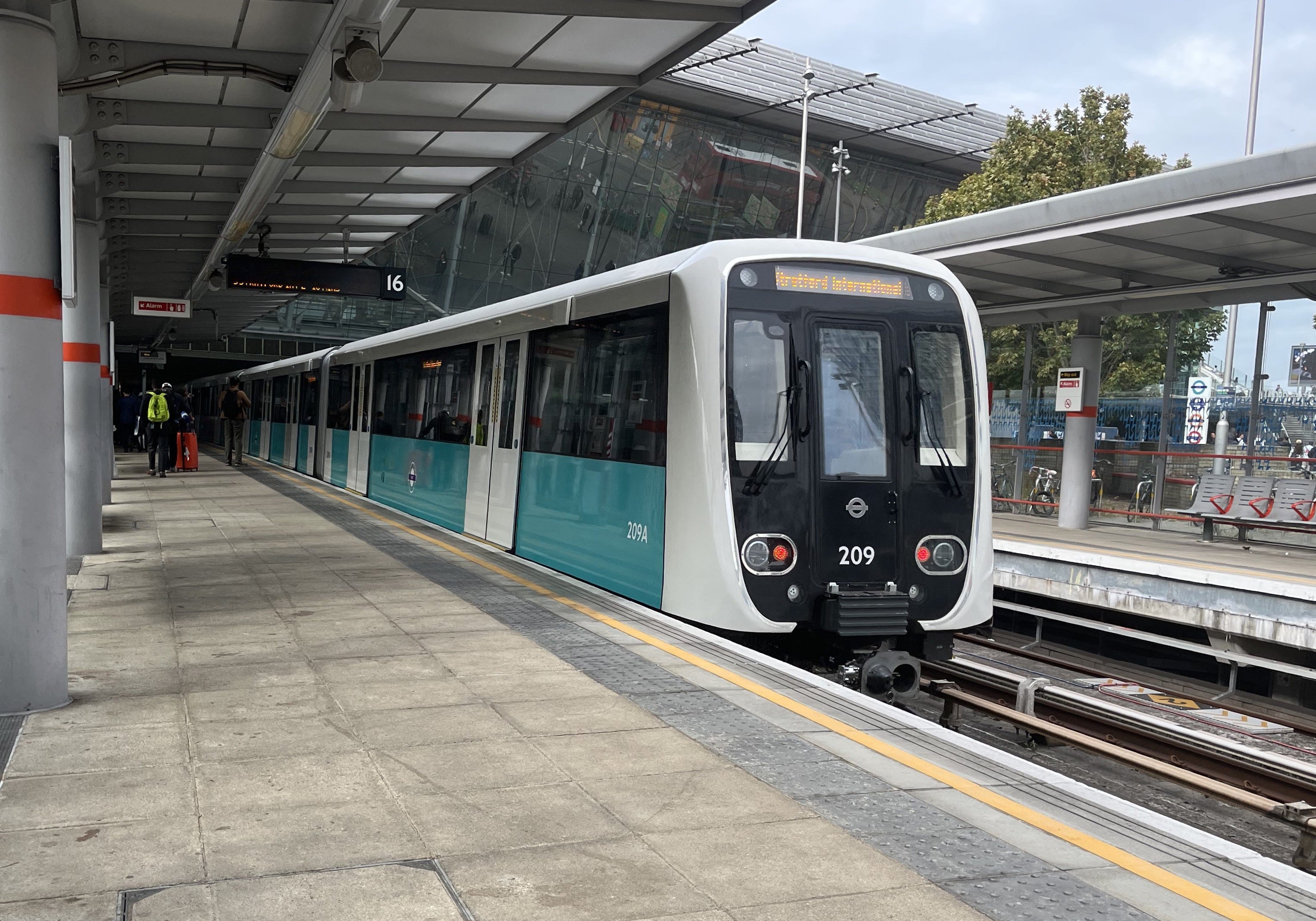
The fifty-four B23 trains will replace around ninety of the oldest trains on the network (B90, B92 and B2K), some of which are not much younger than those in Essen. Thanks to their increased length, this will actually provide an increase in capacity on the DLR, and free-up remaining trains to run in longer sets.
Unfortunately, after about five weeks in service, the new trains were withdrawn having experienced problems with a minor system known as braking. The problem, thought to relate to being able to stop correctly during wet weather, appears to have gone undetected during the something-like-two-years of testing (obviously I jest). I believe only two or three of the trains had actually made it out onto the rails by then, with most of them still stuck in storage in Spain.
As of a few weeks ago, it was announced they’re not due back into passenger service until “late summer 2026”, but I’m not holding my breath given what’s going on with the new Piccadilly line trains (which supposedly… don’t fit in the tunnels1).
But this was a nice little sneak-preview, even if it ended up as a false-start.
Debrief
This post was a bit of an experiment.
While I wanted to write about the new trains (especially given they’re holed up in a depot again) I figured it made more sense to do so by narrating the journey to find and actually ride one, and I’m curious as to what readers think about how it turned out. I’m tempted to lean toward publishing these storytelling posts every so often purely because they’re an absolute joy to write, and because it means I’m not just ranting about things. (And maybe next time I won’t leave it five months before actually putting pen to paper, by which time I’ve inevitably forgotten most of the random observations and anecdote-bait!) This may mean that I’m going to have do more things worth writing about, though.
This is a massive oversimplification of what is a surprisingly complicated but also genuinely fascinating engineering problem that I’m not really qualified to write about (but wish I was).