

Is this the way?
The first Great British Railways branded station is actually a breath of fresh air.

tl;dr: I’m pleasantly surprised by whatever is going on with wayfinding at Cambridge South station.
On Sunday, a new station opened at Cambridge South, serving the city’s biomedical campus.
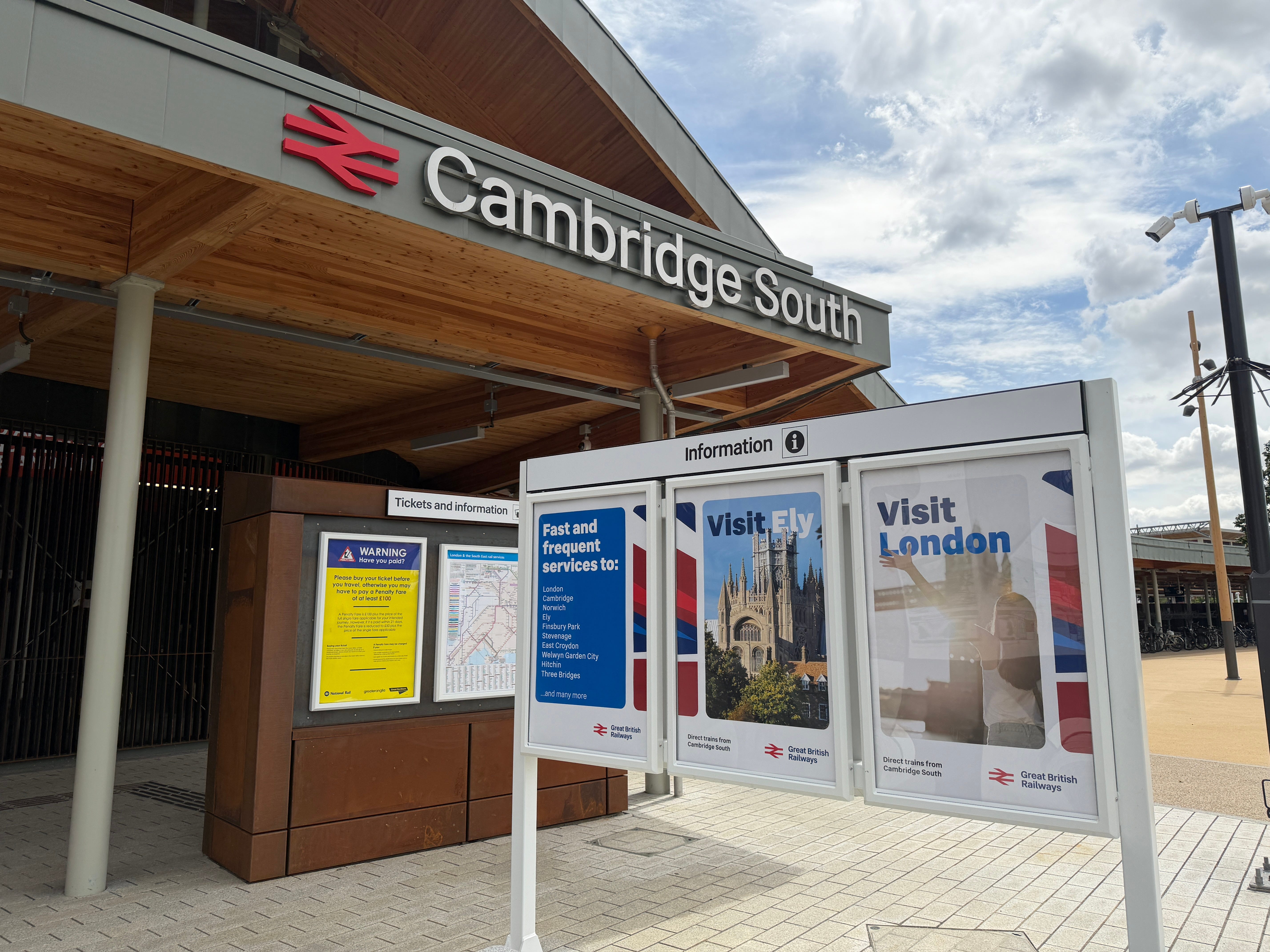
Ordinarily, I wouldn’t be that interested in a new station, but two things immediately jumped out at me:
it was mentioned in DfT press releases as “the first GBR branded station”; and
the wayfinding was completely different to what Network Rail have been rolling out over the last few years.
And because I’m me, and also because I don’t like writing about things without seeing them for myself first, naturally I had to go and take a look.
A quick history lesson.
A few years ago, in anticipation of a customer-facing unification of the railways, Network Rail released a wayfinding system developed by design studio SpaceAgency. This came more or less in tandem with the Rail Alphabet 2 typeface (more on that shortly), and the refined Rail Symbol 2, both of which are variations of those historically used by British Rail1.
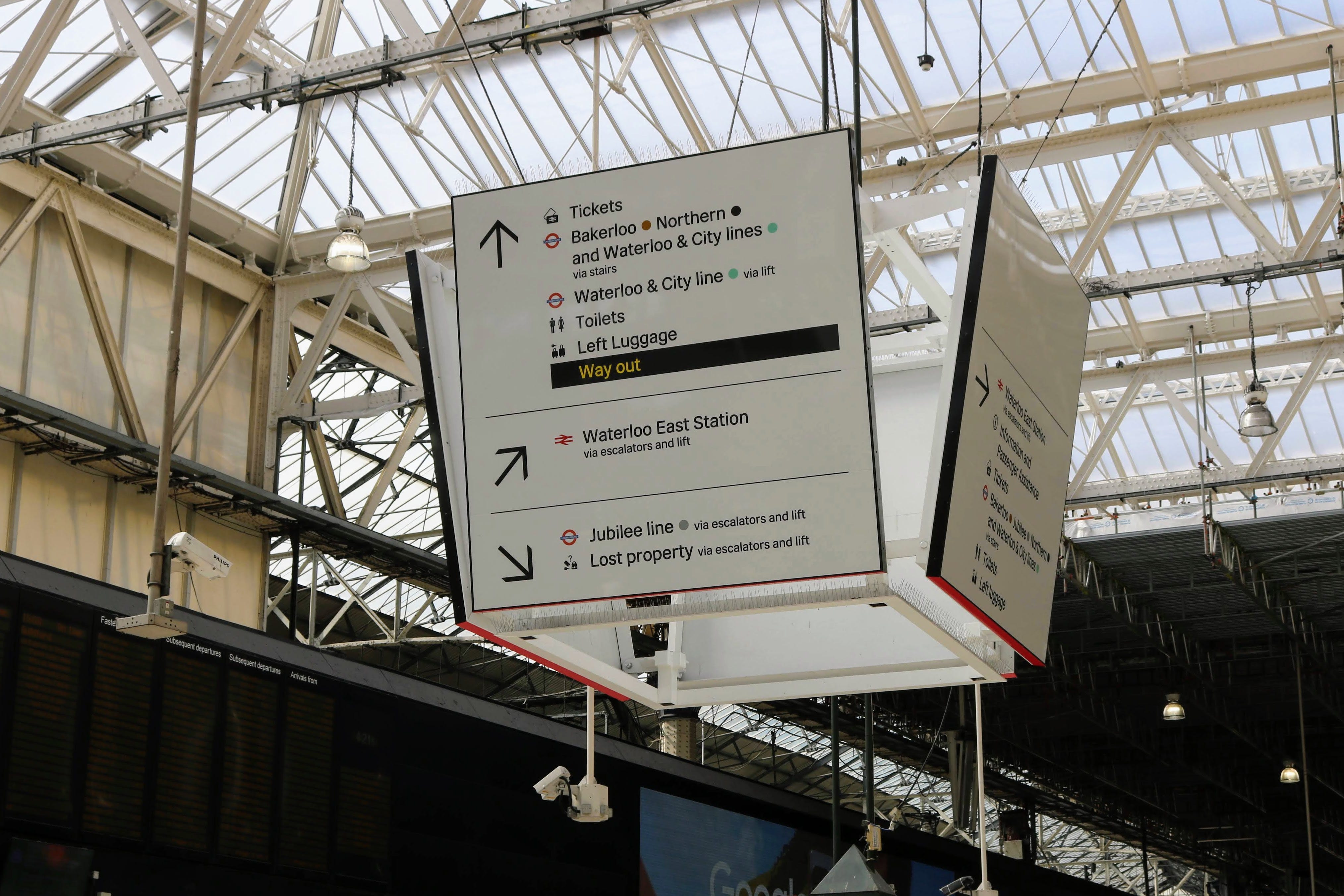
But I have to say, I have always been deeply disappointed with both the wayfinding system and its associated typography. The wayfinding is awkward, hard to parse, prioritises the wrong things and makes design decisions that go against convention. I even went on a whole tangent about how its iconography is a hot mess in one of my posts.
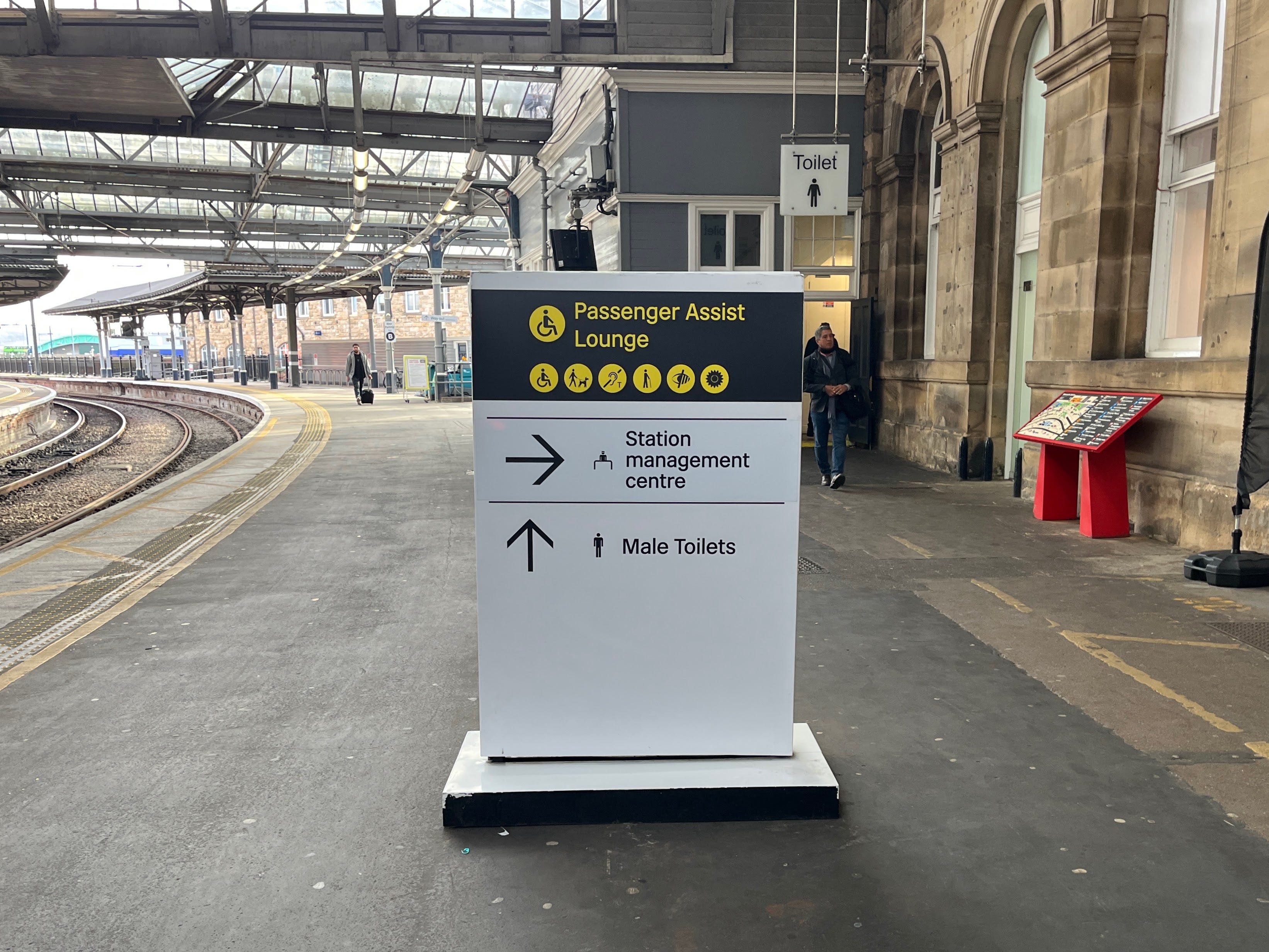
Every time I’ve seen it, I just can’t shake the feeling that “this isn’t good enough”. I’ve wanted to write about it, but a whole post of me ranting probably doesn’t make for enjoyable reading (perhaps my enthusiasm could make it entertaining?)
But anyway, let’s take a look at Cambridge South, because this lovely new £250m station has quite clearly torn apart Network Rail’s wayfinding manual, and I’m pleasantly surprised by the result.
The station.
Cambridge South station lies, quite intuitively, in the south of Cambridge, and is served by Greater Anglia, Thameslink/Great Northern and CrossCountry trains (of which the former two have returned to public ownership). It’s a very, very nice station, and vastly different to the cookie-cutter ugly blocks we’re usually treated to.
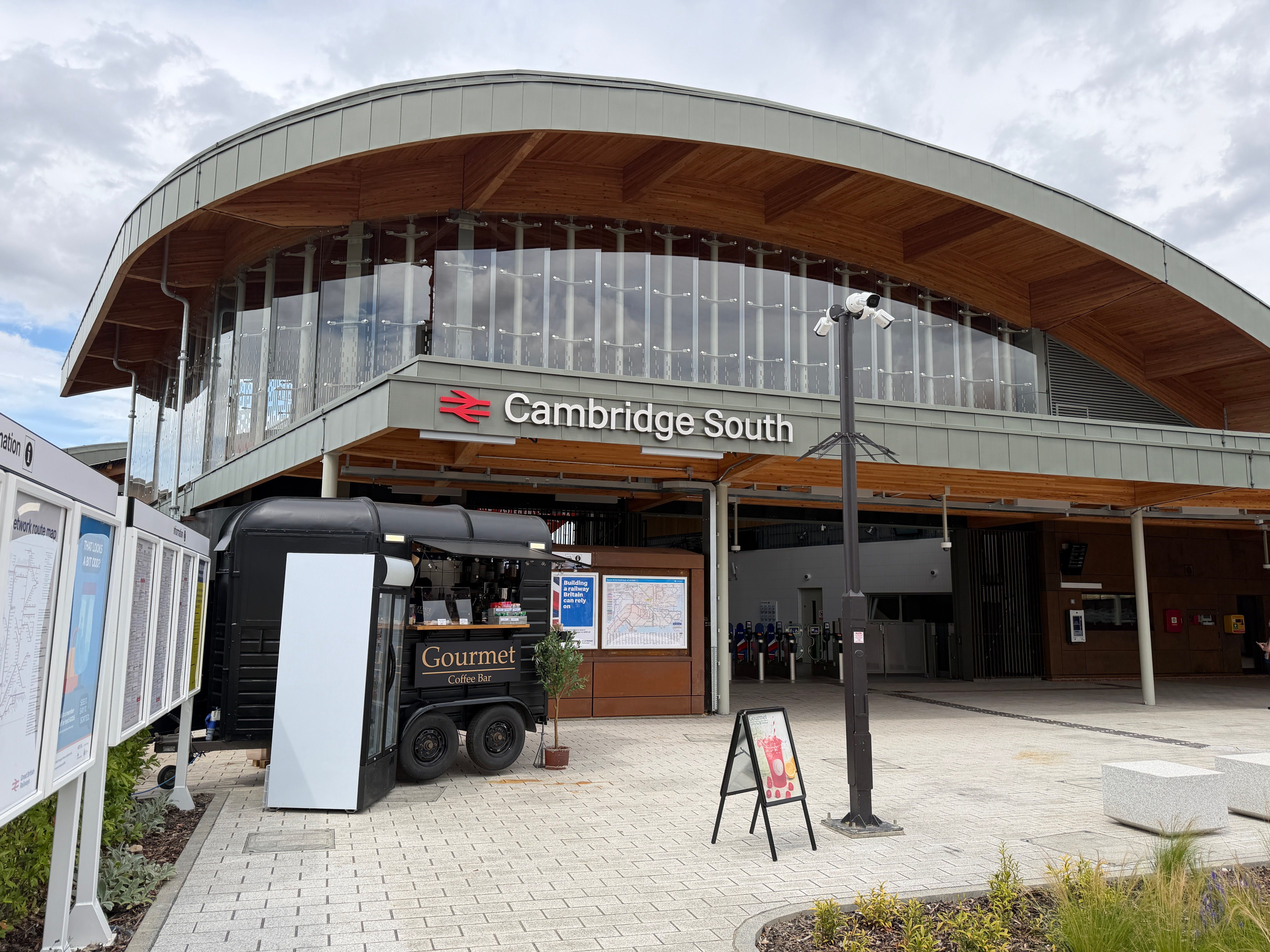
The main station building features green roofs and platform canopies that are made from glass with embedded photovoltaic cells (so… solar panels), which is very nifty.
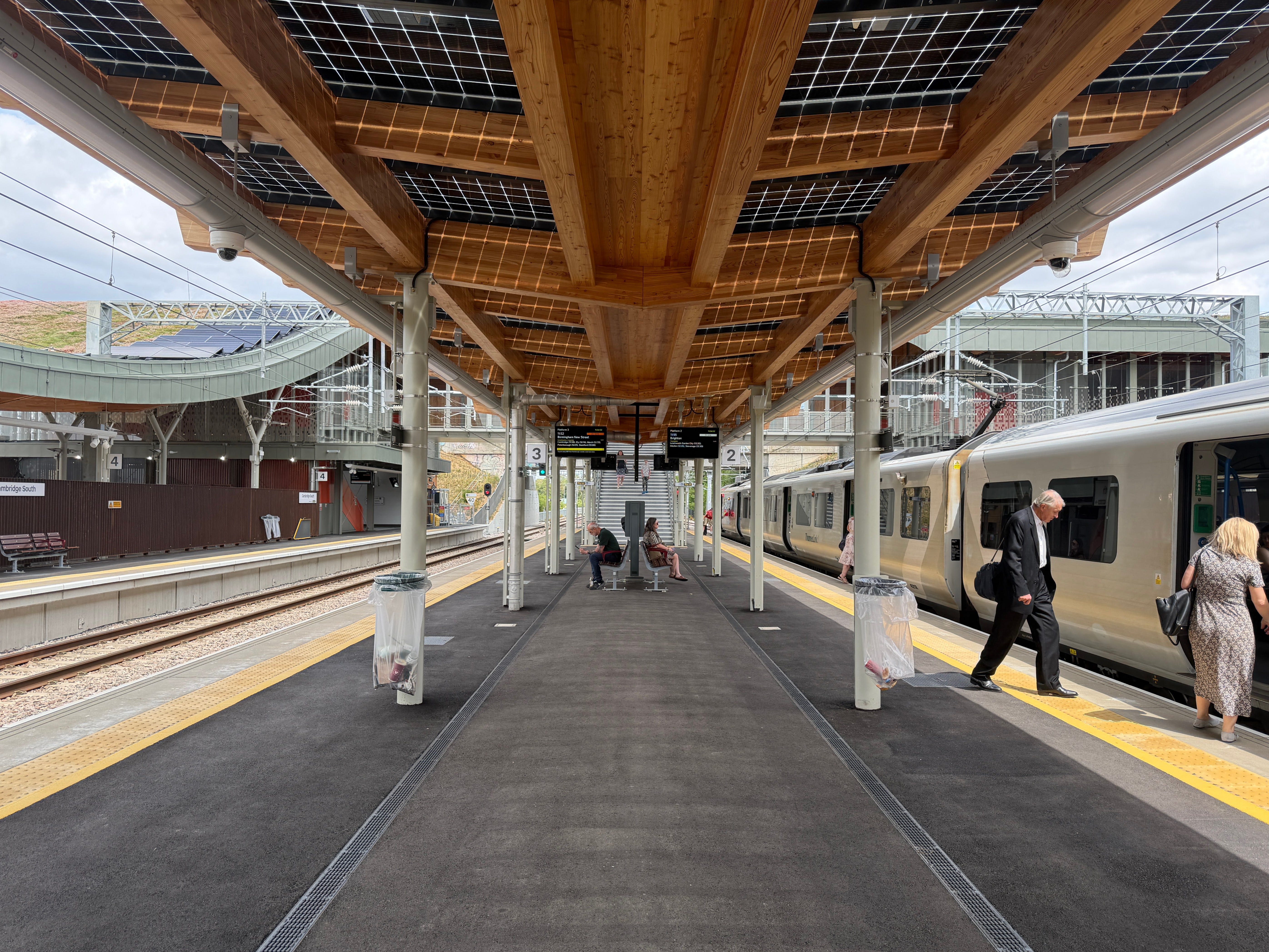
There’s cycle storage for around one thousand bikes split over the two sides, and a grand total of eight parking spaces, of which three are reserved for staff and the remaining five for blue badge holders.
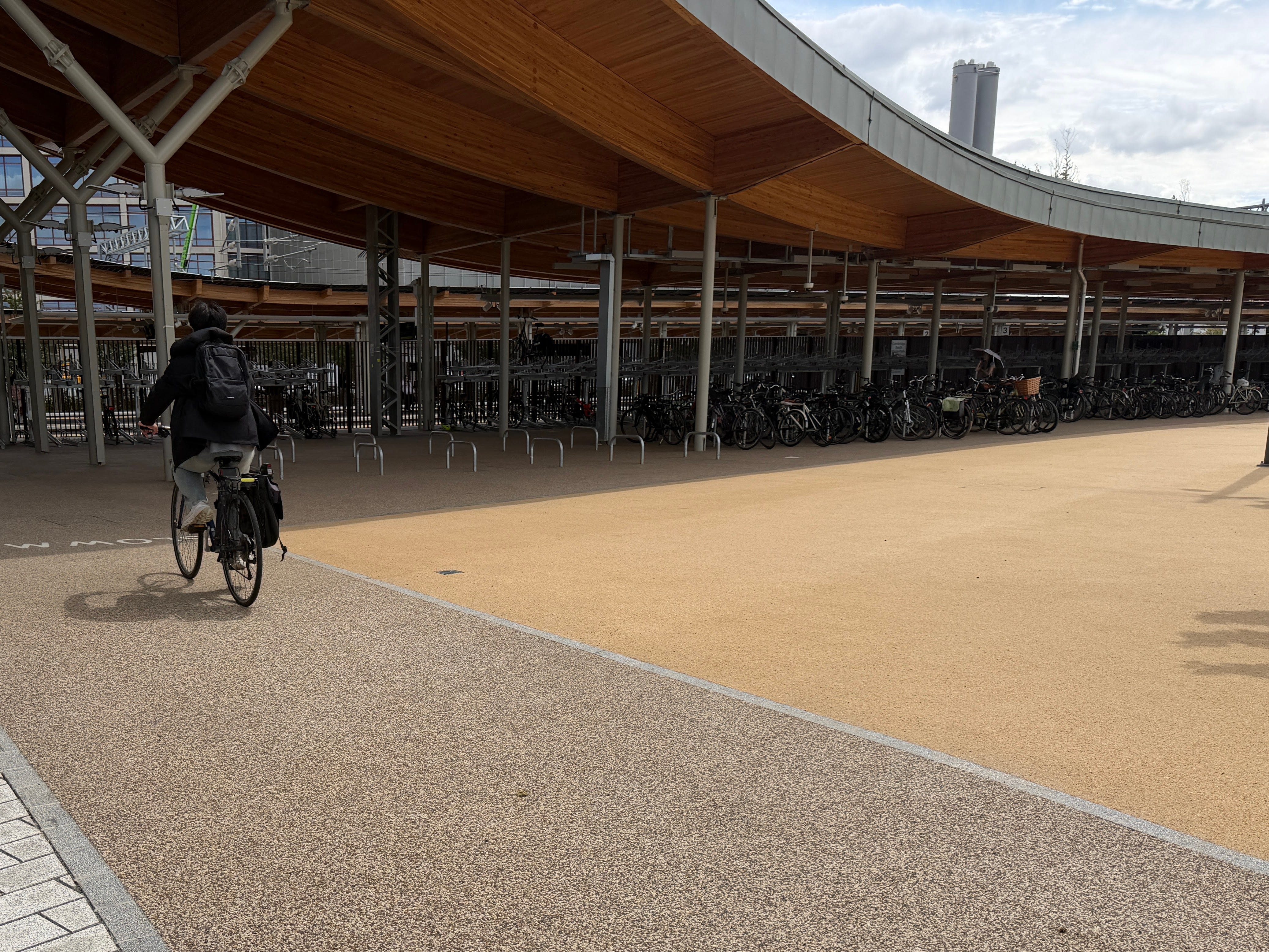
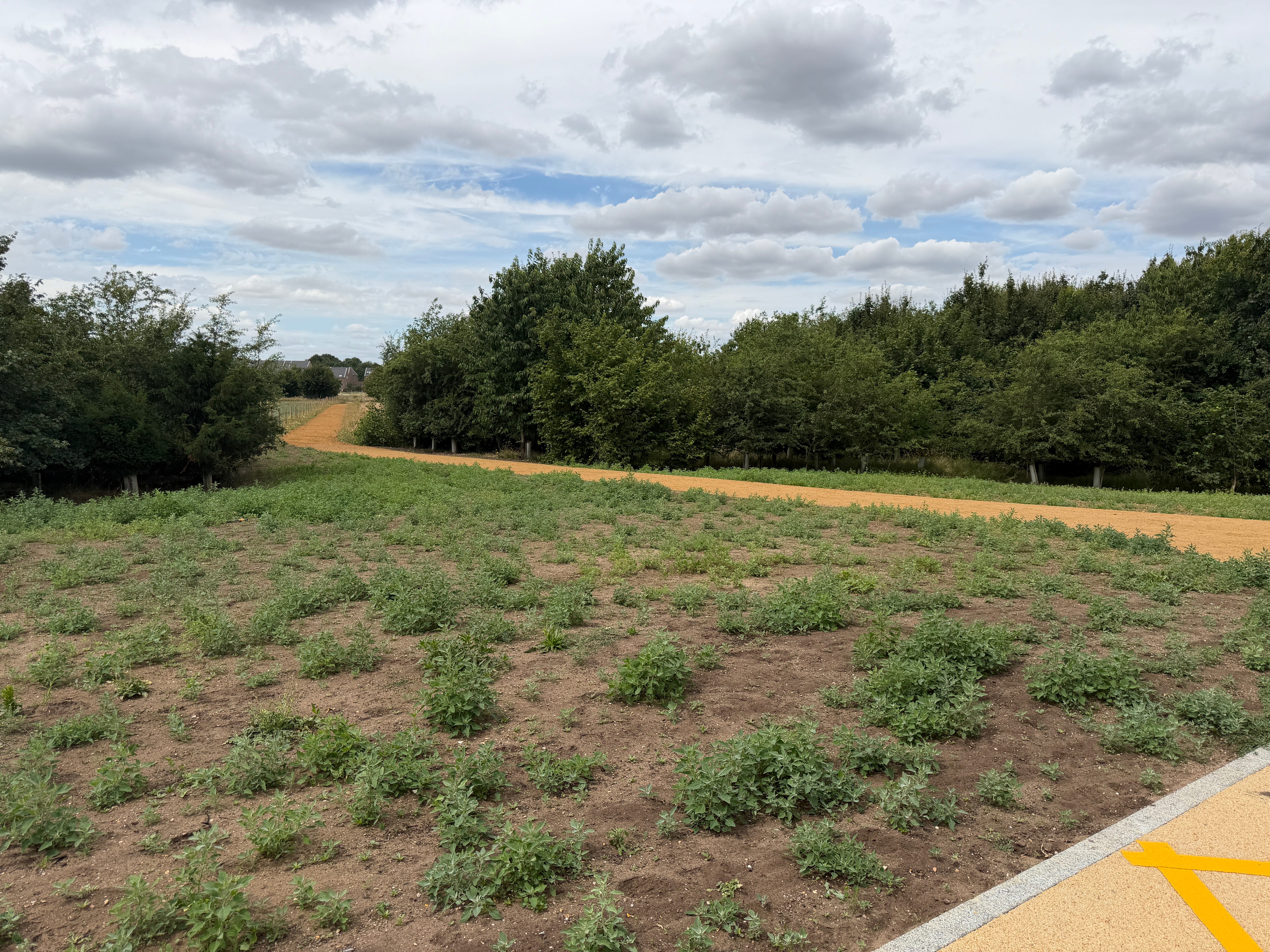
The Cambridge biomedical campus lies to the eastern side of the station, with the likes of AstraZeneca and Cancer Research UK, alongside specialist hospitals. To the west, there doesn’t seem to be very much at all:
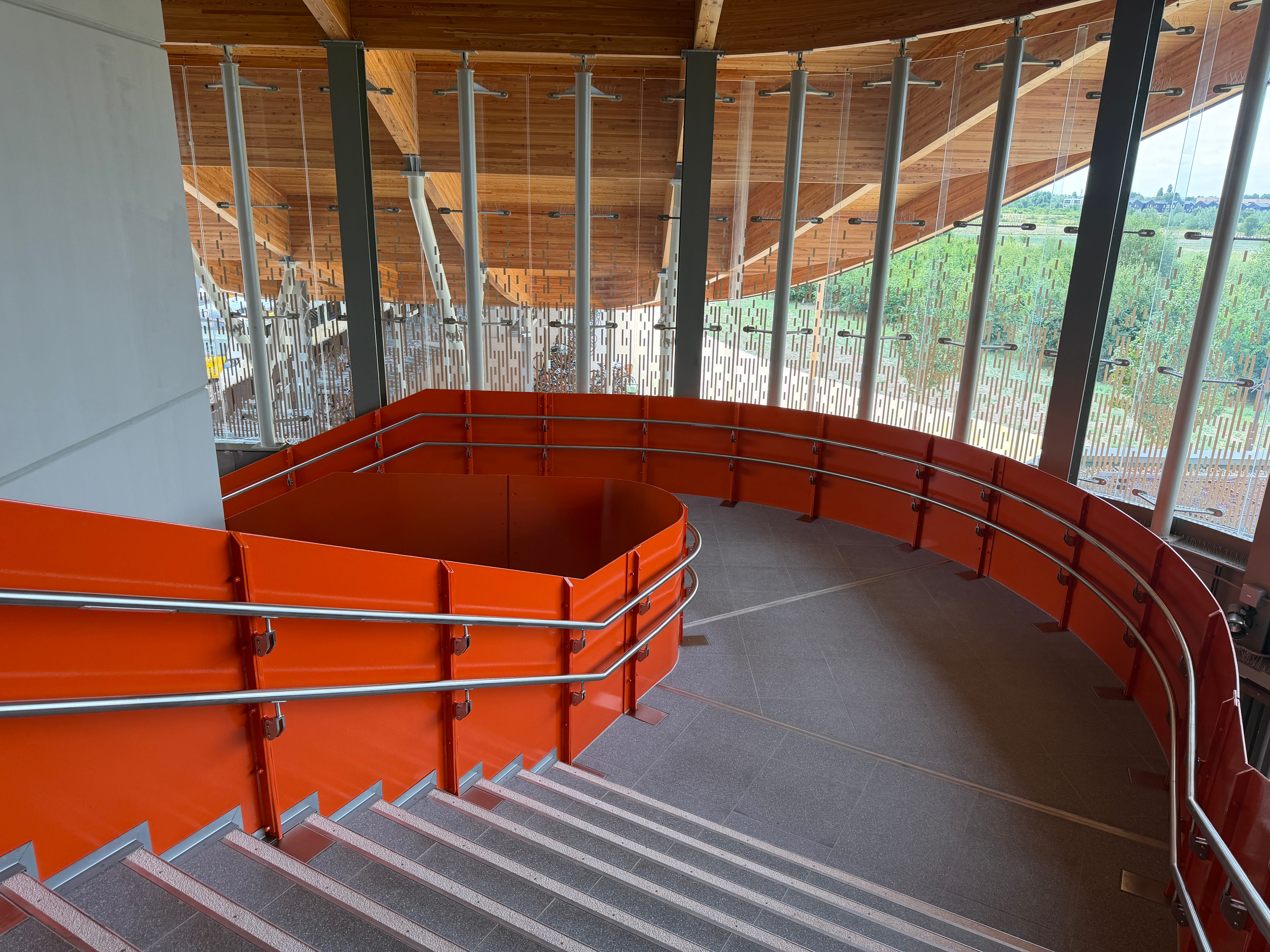
Inside there are lifts and platforms and ticket machines and toilets, in addition to some very friendly staff, and some very orange staircases.
As you can tell, I’m not much of a station reviewer, but that’s the main press release points out of the way, so let’s crack on with what matters:
On wayfinding.
The thing I’m struck by with the new wayfinding found at Cambridge South is that it seems to be putting function over aesthetic, and generally speaking, that’s a good line to draw. I’m genuinely quite charmed by it, even though it’s very plain.
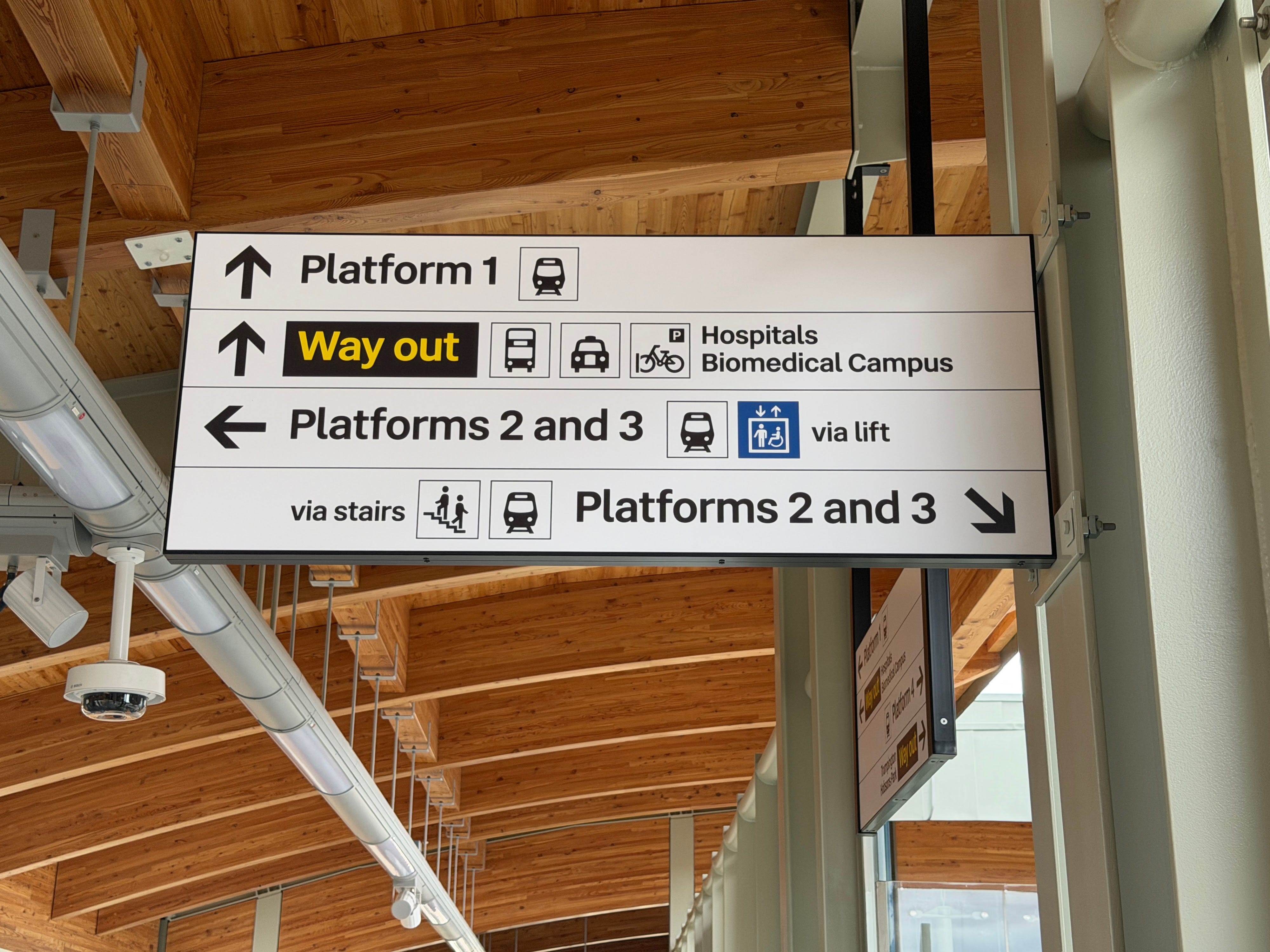
The text is heavy, clear, well contrasted, and uses the latest version of Rail Alphabet.
The arrows are strong, and because of its modular nature, repeated for each line.
Arrows going to the right remain on the right, rather than trying to justify keeping them all on the left in certain circumstances (which is an artistic choice and nothing more, no matter how hard some people might try to justify it).
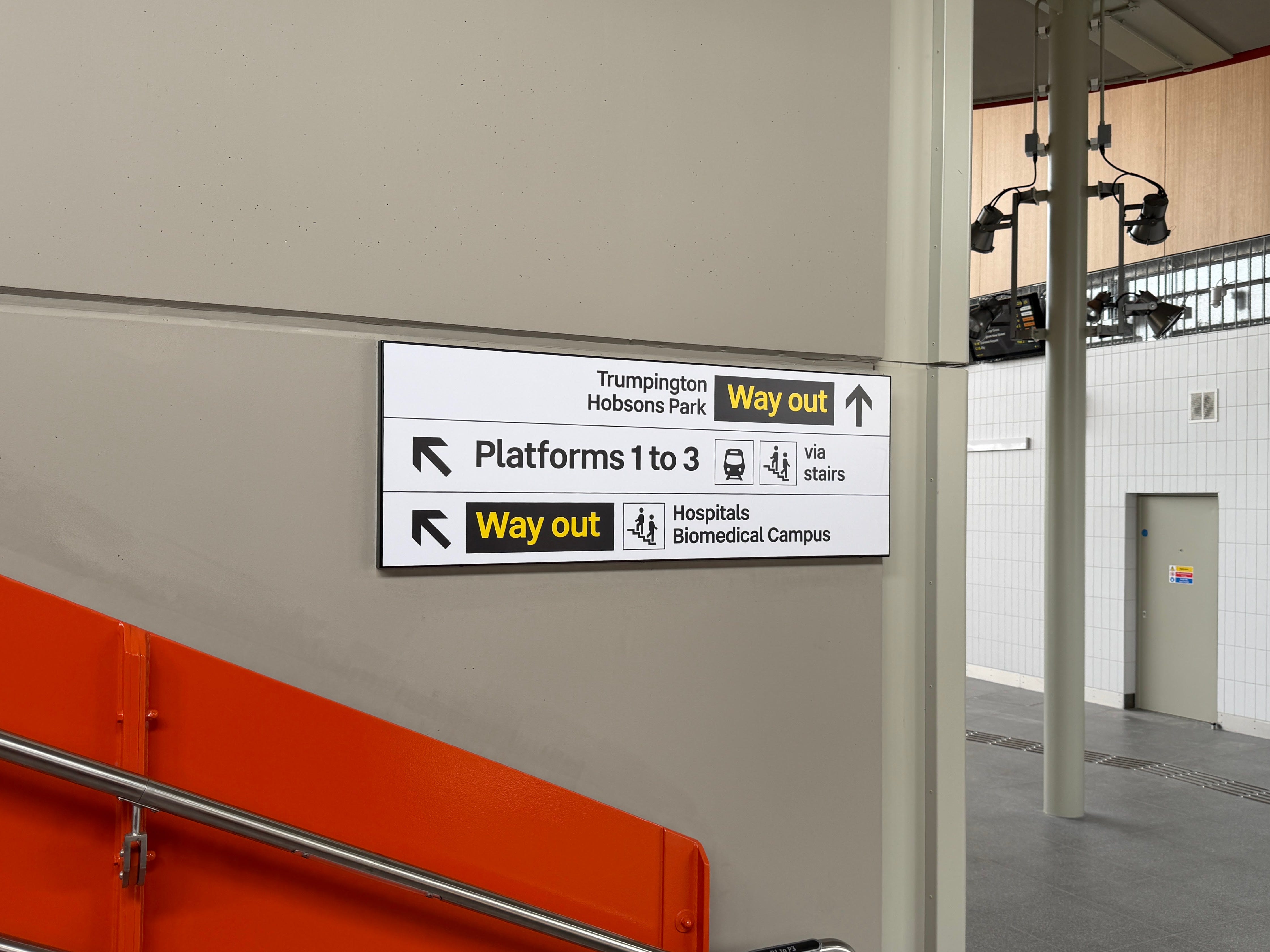
The iconography is not perfect, but it exists, is clean enough, and is used to augment and aid comprehension of the main information being conveyed rather than replace it. (There are lots of arguments about whether iconography should lead or be secondary and I could write a whole post on them but I feel like this works well.)
Way out information is highly contrasted (Nexus, take note!) in yellow on black (although I’m not sure my designer’s eye agrees with the horizontal alignment of the ‘Way out’ boxes in more ways than one.) Those points of interest reachable from each exit are also clearly listed.
And emergency/fire exit signage is kept completely separate, which is a sensible choice and leaves safety as an isolated concern.
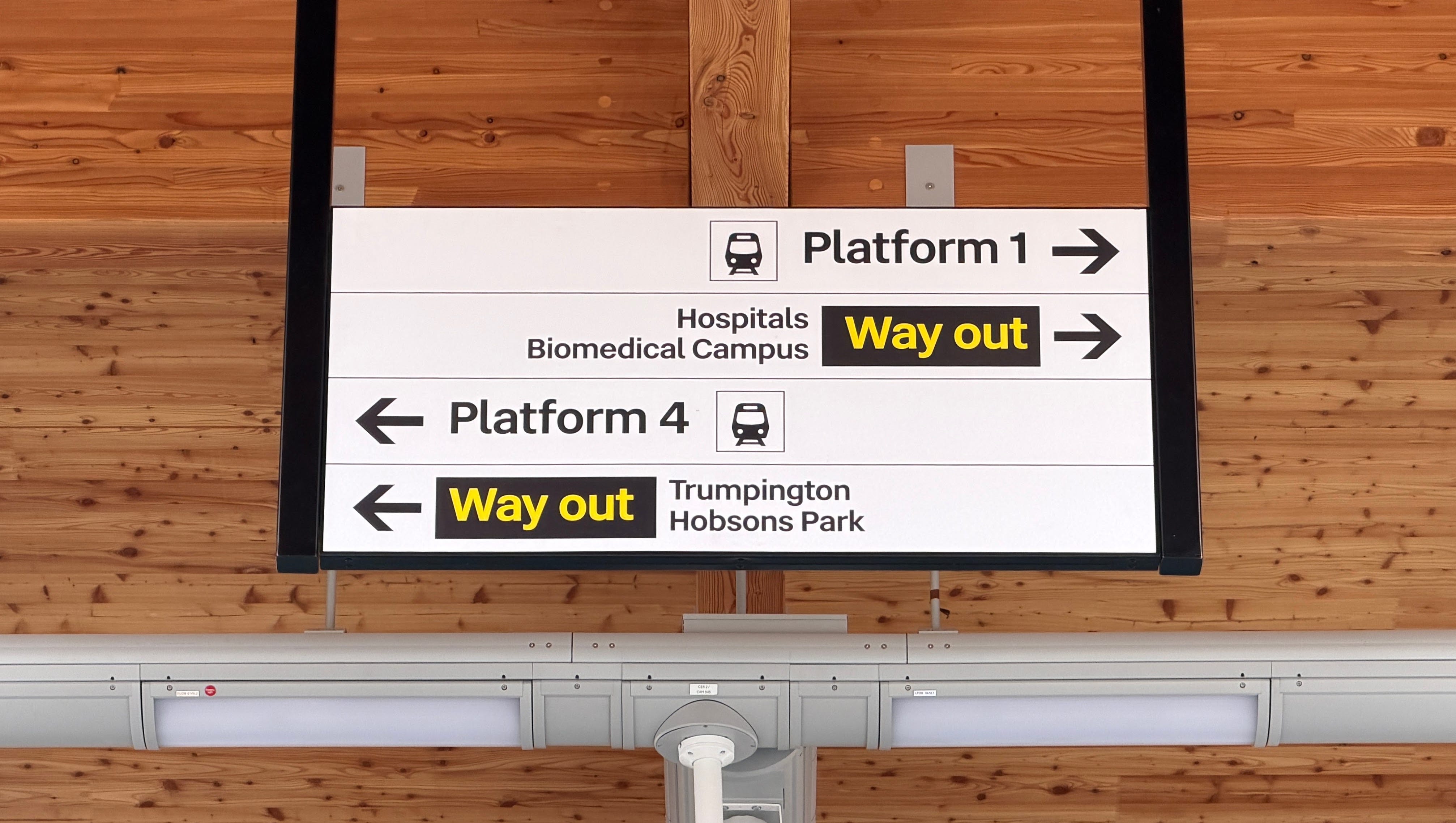
All in all, I find it really hard to criticise from a functionality perspective. Could it be better? Probably. Is it perfect? By no means. But most importantly, and relative to what else we’ve seen, I have to stress: This. is. better.
Typography refresh refresher.
In the sixties, a typeface known as Rail Alphabet was developed for British Rail by the much-revered Jock Kinneir and Margaret Calvert.
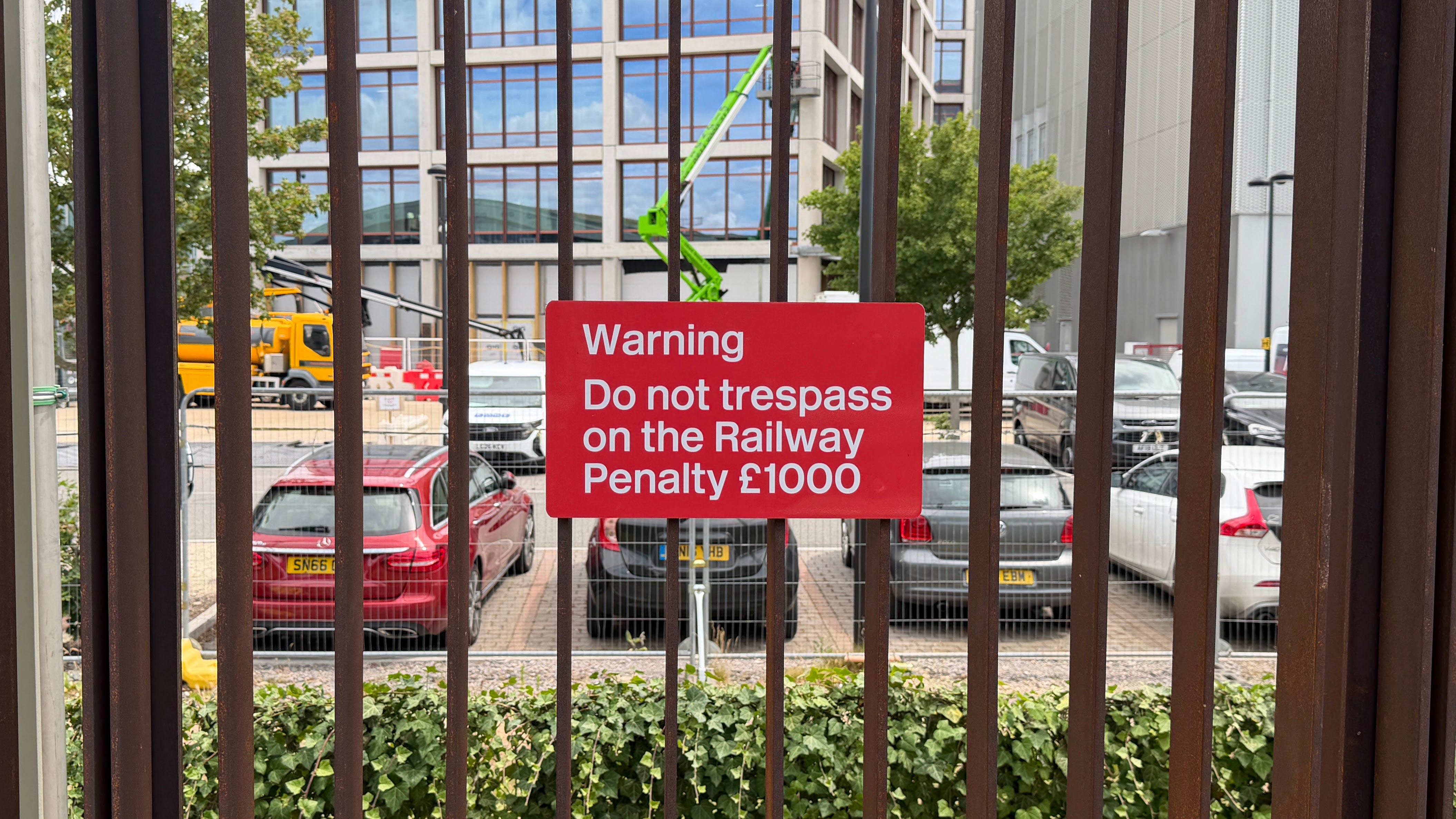
In anticipation of Great British Railways, Calvert (who’s just turned 90 with a superb cake) was tasked with refining Rail Alphabet for the digital world, and so Rail Alphabet 2 (or RA2) was born.
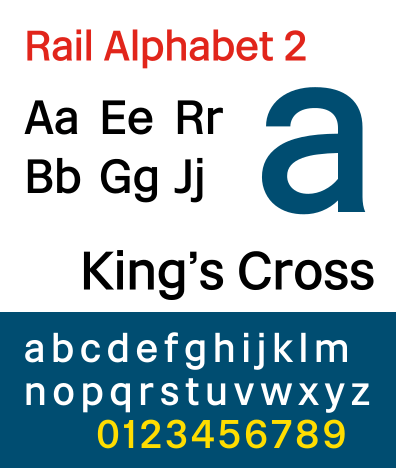
As much as I’m generally a fan of Margaret Calvert’s work (particularly the Calvert typeface used on the Tyne and Wear Metro, and Transport typeface used on road signs and more recently adopted by government), Rail Alphabet 2 was very much an exception.
The original Rail Alphabet struck me as a more characterful and perhaps charming Helvetica, but its successor made a significant departure from this. The result was something that didn’t feel like a refinement but an entirely different font, and one which I personally found to be spindly and awkward (it gives Candara vibes at lower weights), and probably not worthy of use by a national institution.
Since then, though, a revised version of RA2 has subtly been introduced in GBR materials, which has been unofficially dubbed “Rail Alphabet 3” (although I’m not sure the differences justify a whole new version number - I’d call it RA2.1, or RA2A, myself…) and which I personally feel is closer to its roots. I really rather like it.
Unfortunately, RA2 has already seen widespread use on wayfinding rolled out at stations across the country, meaning we now have - as ever - an incoherent and inconsistent mess. (Slow clap…)
At Cambridge South, fortunately, almost all typography was in Rail Alphabet 2.1 (or 2A, or 3, as you prefer), and I don’t recall seeing anything in Rail Alphabet 2.
GBR branding.
I find it interesting that this was pitched by the DfT as “the first GBR branded” railway station, because, well, is it really GBR branded?
One recent station to open, Beaulieu Park (a soup of vowels that I had to look up the correct arrangement of) featured Greater Anglia branding and wayfinding, despite the franchise having (just) returned to public ownership by then.
Cambridge South is decidedly not a Greater Anglia branded station, despite being managed by them, with the name only appearing in a few places on timetables and other posters. And the wayfinding is distinctly not that of Greater Anglia - so where on earth has it come from?
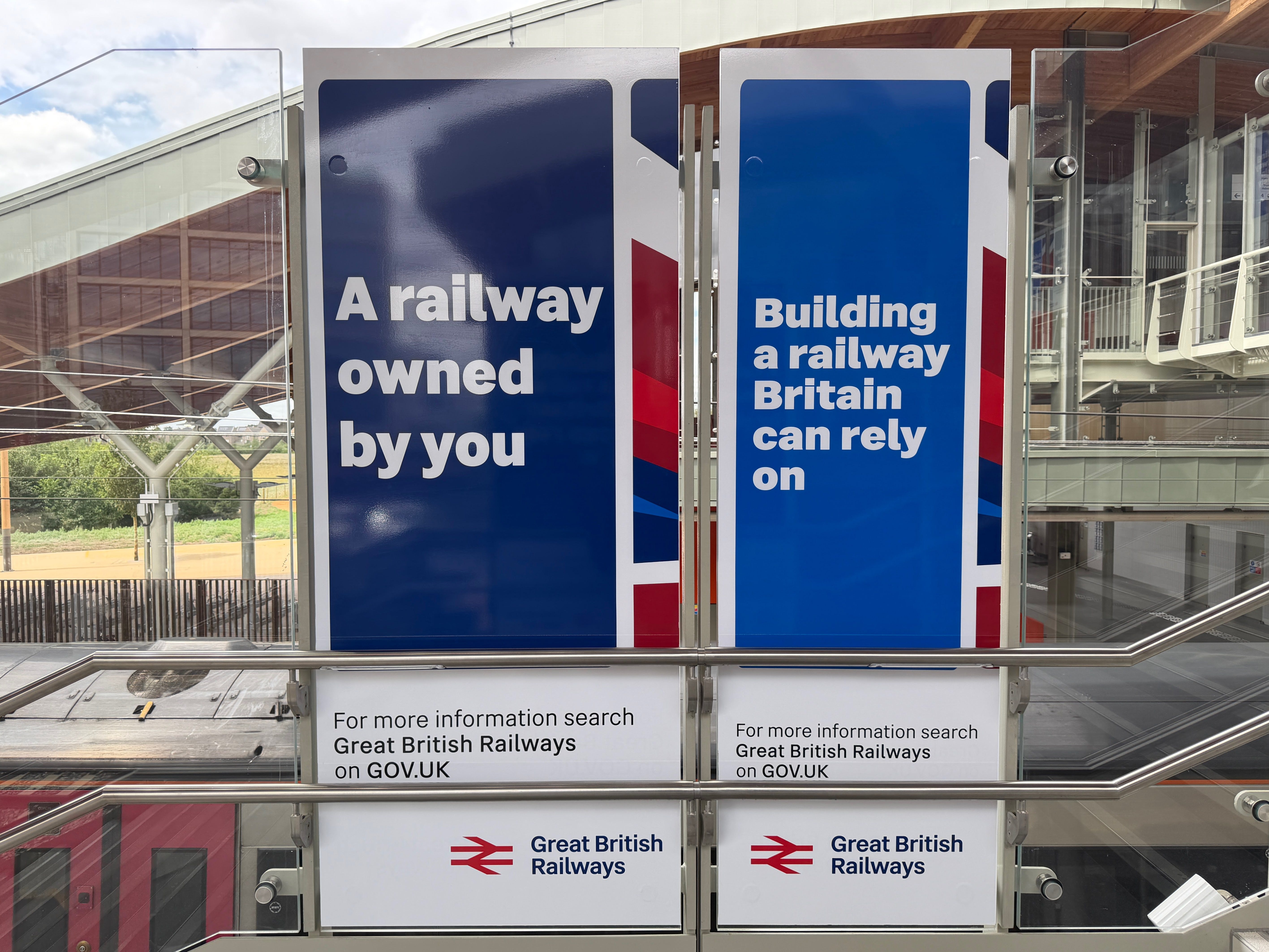
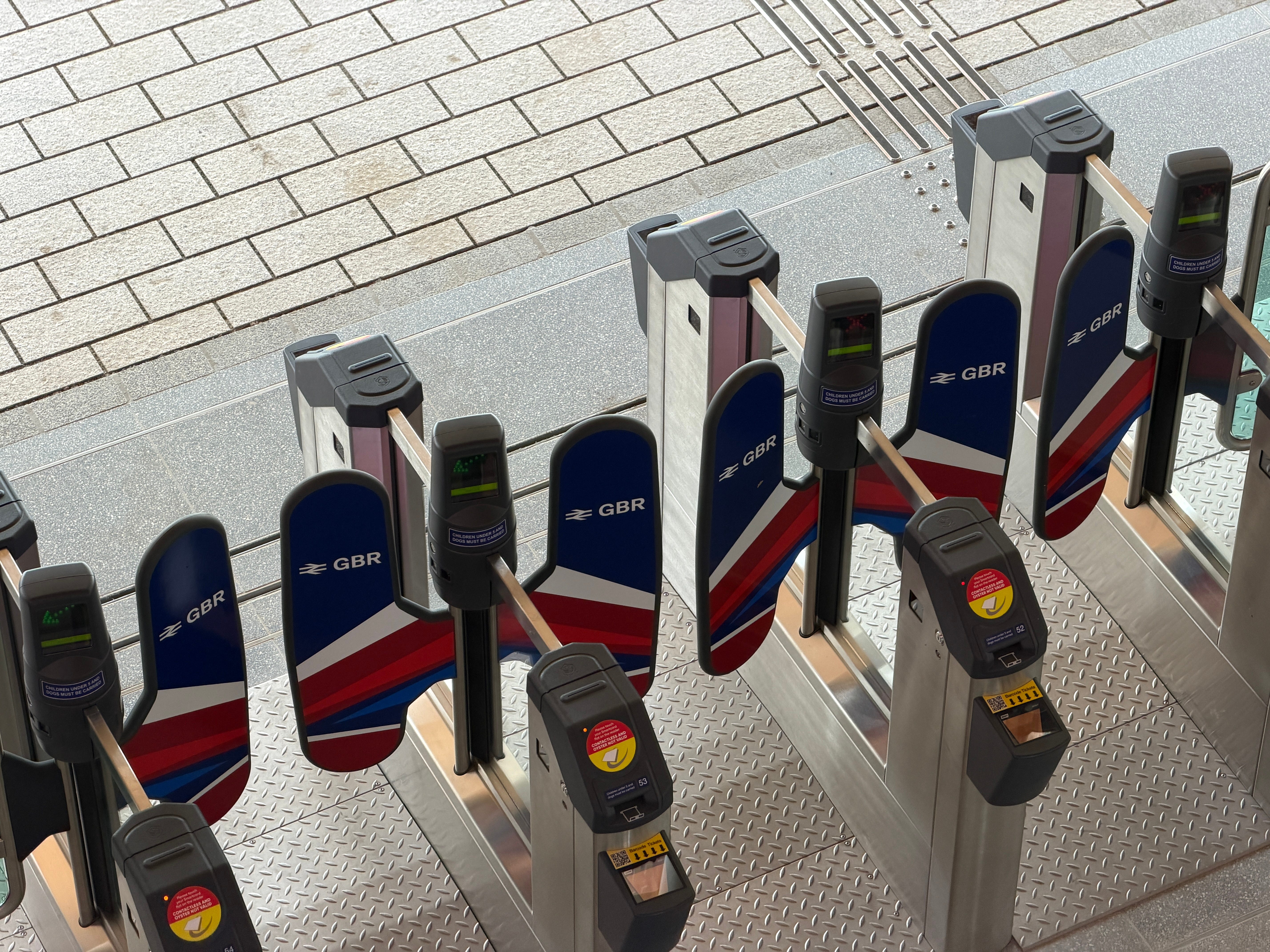
As for GBR, there are lots of posters around the station that are clearly Great British Railways branded, the ticket barriers have GBR stickers on them, and even the water dispensers are in GBR ‘livery’:
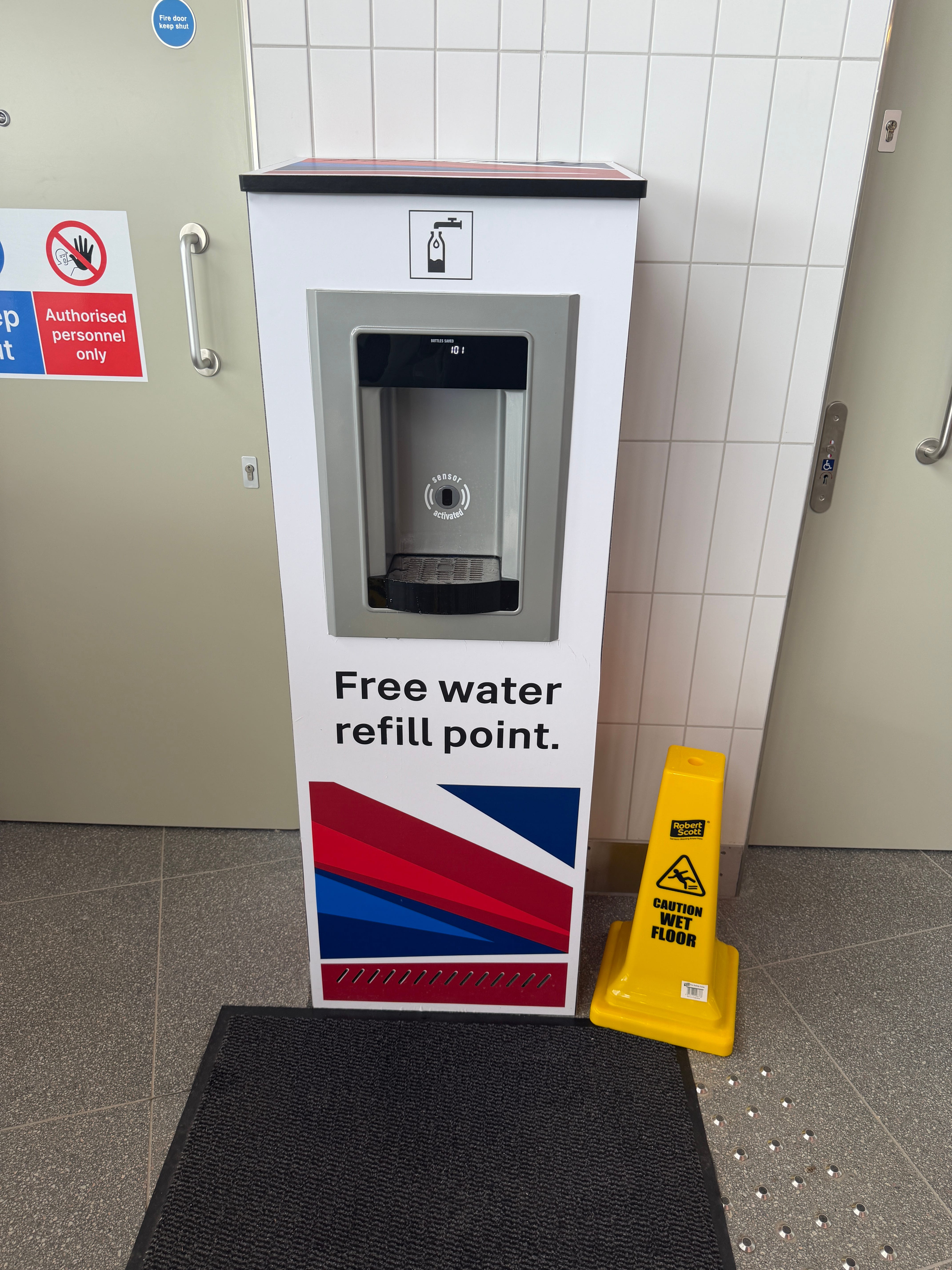
But beyond this, there wasn’t really that much explicit GBR branding at all, and I think that’s probably a good thing. Ultimately, if you peeled off all the stickers, and took down the posters, it wouldn’t be a branded station at all. The brand is carried - expressed, maybe - by the double arrows and the typeface, as it should be. This also leaves the door open for future improvement, rather than baking in bad design.
End.
Cambridge South is quite refreshing, as far as GBR-related developments go. It’s pretty clear that Rail Alphabet 2 has been ditched by GBR, and I’m really hoping what we see here means that the Network Rail wayfinding guidance has also been shown the door.
This new wayfinding is much stronger than what came before it, and while it may be boring and plain, it strikes me as a move in the right direction. I’ve seen already that some people feel differently, but I reckon I can justify my perspective - wayfinding should be utilitarian, human and accessible. And this is exactly that.
I suppose we’ll find out if this is the way forward at subsequent station openings or rebrands.
If anyone is listening: More of this, please.
Other interesting tidbits from Cambridge South:
There’s tactile wayfinding throughout the station, but there didn’t seem to be any meaningful accompanying layout diagrams to allow its users to build a mental model of where they’re going, as they have in Italy. (Something to write about!)
Certain signage featured braille (such as that outside of lifts, toilets, etc.) which is an excellent touch (quite literally).
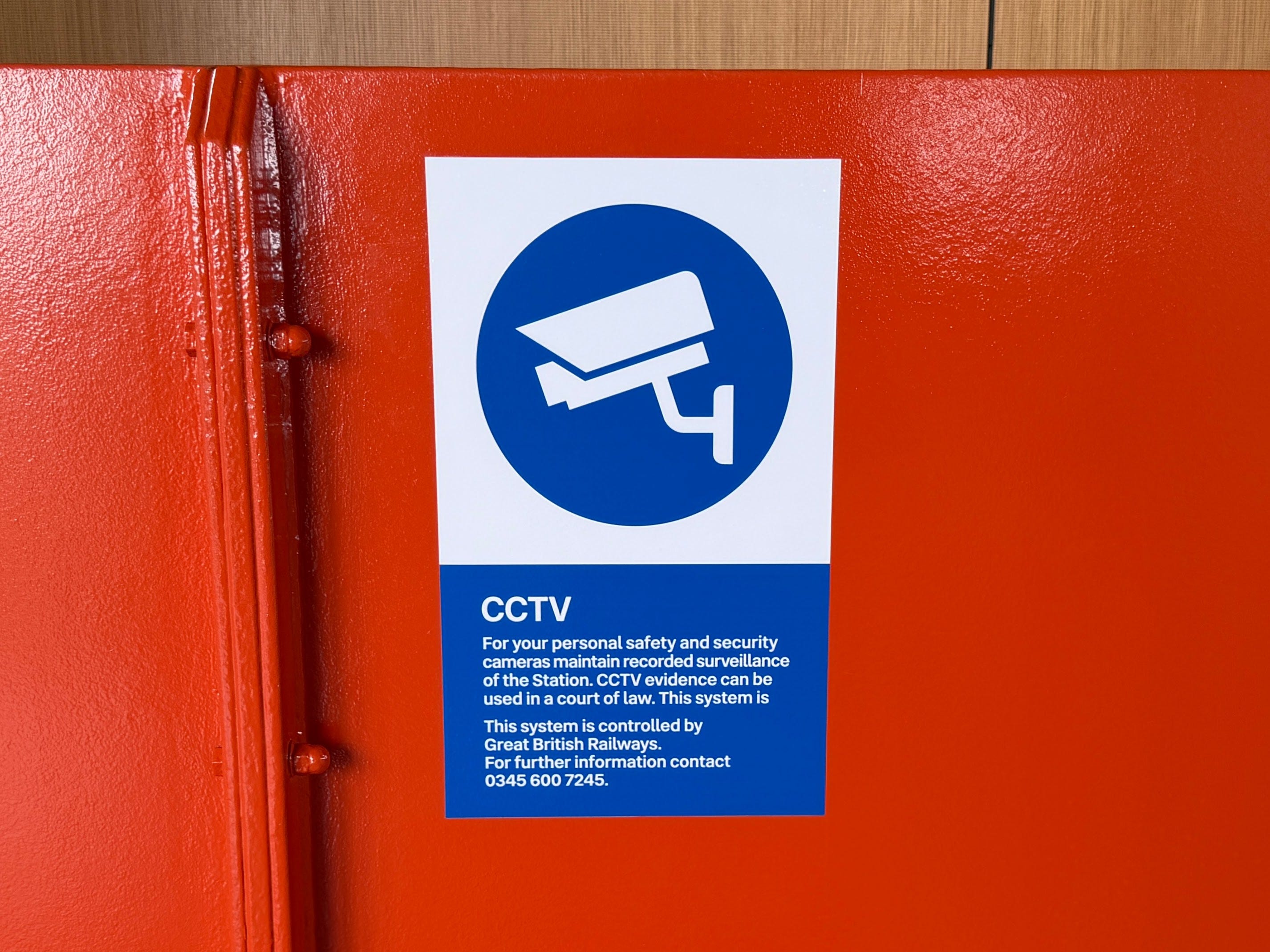
GBR can’t seem to decide if it’s using full stops or not. The posters don’t feature them, but the CCTV sign and the water dispenser branding do. Let’s hope they choose to drop them much like TfL - they’re not necessary in most cases.
The longest guided busway in the world (or at least a part of it) passes immediately north of the station and ends by the station approach.
The Blackbox passenger information screens (my favourite) aren’t currently GBR ‘themed’, but this is just a software update that I expect we’ll see eventually (hopefully at the same time as removing that stupid clock.)
More GBR related reading:
The GBR clock is a bit pants.

tl;dr: The new railway clock looks nice, but complicates telling the time in an environment where seconds matter.
I honestly can’t tell the difference between the original double arrows and Rail Symbol 2, but I respect the refinement work that’s gone into balancing it. Put them in front of me, though, and I probably wouldn’t be able to tell you which was which.