

Countdown: What's next?
The clock's ticking on the current generation of Countdown, but it's not clear why.

tl;dr: Despite trials of various prototypes to replace Countdown, nothing quite lives up to the strengths of the original.
After looking at what’s wrong with Countdown and how it could be better, let’s take a look at what’s next for Countdown.
The current generation of Countdown is (in technology terms, at least) a mature system - the oldest screens on the network are pushing 15 years old, and in that time technology has moved on considerably. But do we really need to change the basics that make Countdown in its current form so effective?
Early prototyping
No sooner had the first current generation Countdown screens been installed, TfL were already experimenting with ways to replace it.


Prototypes ranged from large, full-colour touchscreens coined ‘interactive bus stops’ in 2014, to e-ink displays that fit onto timetable frames in 2015 (notably displaying next bus departures by route, rather than by next arrival - hooray!) and screens built into flag signs showing the next two arrivals in 2016.
As far as I can tell, none of these remain out there in the wild.
Countdown to sunset
Much like my dearly beloved Google Reader, Countdown appears to be heading towards ‘sunset’.
It’s my understanding that as screens fail, become damaged or get vandalised, they’re being removed with no plans for repair or replacement, which is extremely disappointing - providing real-time passenger information should not be considered a luxury, and we certainly shouldn’t be reducing its provision. TfL’s website also states they have no funding for new screens, and that individual boroughs need to fork out if they want new devices installed in their area.
Route 63: the test bed
In recent years, bus route 63 has been TfL’s petri dish, either as a result of deeply complex, super classified transport-insider reasoning, or because happens it runs right past their Southwark offices (honestly, it’s anybody’s guess).
With shiny new electric buses featuring high-backed seating, fancy faux-wooden flooring and glass skylights, the route has been used to pilot the new iBus, digital destination blinds and most recently, the latest generation of Countdown replacement candidates:
E-paper tablets
From 2023, an e-paper tablet which can be mounted to the bus stop pole was rolled out at selected stops along the route. These devices are doing double duty, trying to replace both Countdown and paper timetables, with buttons to switch between them.
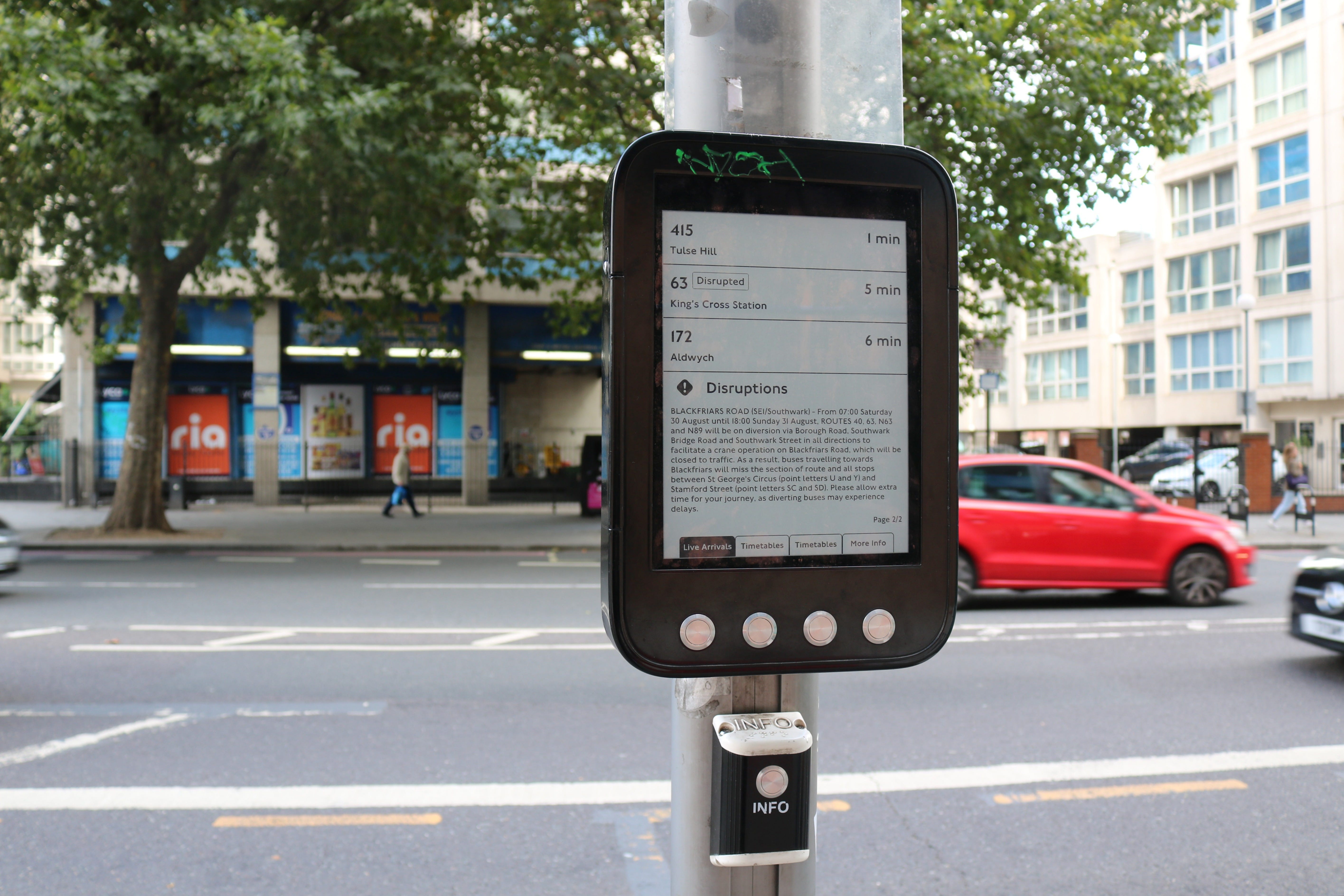
While I was initially deeply skeptical of these as gimmicky, after some first-hand experience, I’m completely sold as a paper-timetable replacement and in accessibility terms. I have to say, they are fantastic. Full disruption information, timetables, route maps and general TfL help stuff. They even talk!
They show arrival information ‘route-first’ style (+5 points), but disappointingly routes are sorted by order of next arrival (-1 point). The hardware seems robust enough and I can see them standing up to the inevitable physical abuse and vandalism they’d face, given their design invites it more than that of Countdown proper.
Flag sign displays
Another prototype rolled out on the 63 is a new version of the flag sign screen - this time incorporating an e-paper display showing the next four arrivals at the stop.
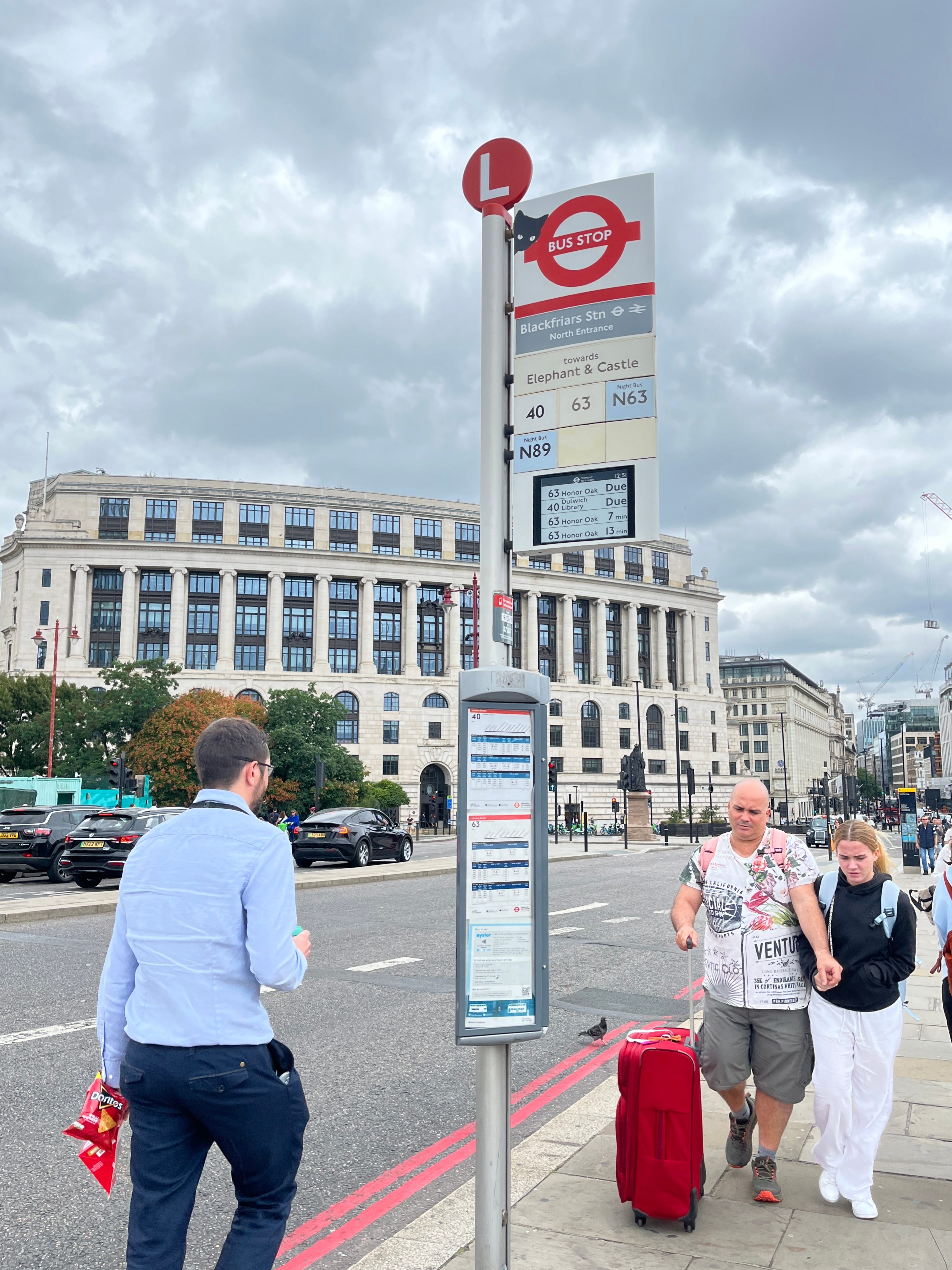
I was able to find these on Blackfriars Bridge, and it’s fair to say I’m considerably less impressed. The screens are high up, and pretty small. They won’t suffer much vandalism though, because - like most passengers - any would-be vandals won’t notice they’re there. They also list arrivals by bus, rather than by route (boo!). I’m not sure why the designers felt it was necessary to waste limited screen real-estate on displaying the TFL logo, either.
Why the prototypes aren’t replacements
There seem to be a bunch of different goals at play with these newer prototypes, and I think ultimately this is their shortcoming as prospective replacements. None of these devices try to replicate what Countdown already does well, instead they’re all off trying to reinvent the wheel.
It seems they’re focused on developing something they can roll out to bus stops across the network that might not have a shelter or mains power. This is a great ambition - having near-universal arrivals information and replacing paper-timetables across the city’s 19,000 bus stops would be nothing short of impressive.
E-paper screens that can be mounted on the bus stop pole (there might not be a shelter), connect by mobile data and only require a battery to be swapped every so often are perfect for that approach. As I’ve already said, the little tablets are excellent - in fact they’re so good that even I can overcome my unease at having permanent infrastructure be battery-powered.
But what’s oh-so-important to realise is these ideas are not suitable for replacing Countdown.
A tablet on the bus stop pole or a tiny display on the flag sign isn’t going to be as useful in a bus shelter crowded with people who want to be able to glance up above the crowd and see the information they want. What’s more, when you have that information available, it’s habitual to keep an eye on it as the arrivals time ticks down. After all, a bus can get bogged down in unexpected traffic or get ahead of schedule, so might arrive earlier or later than expected.
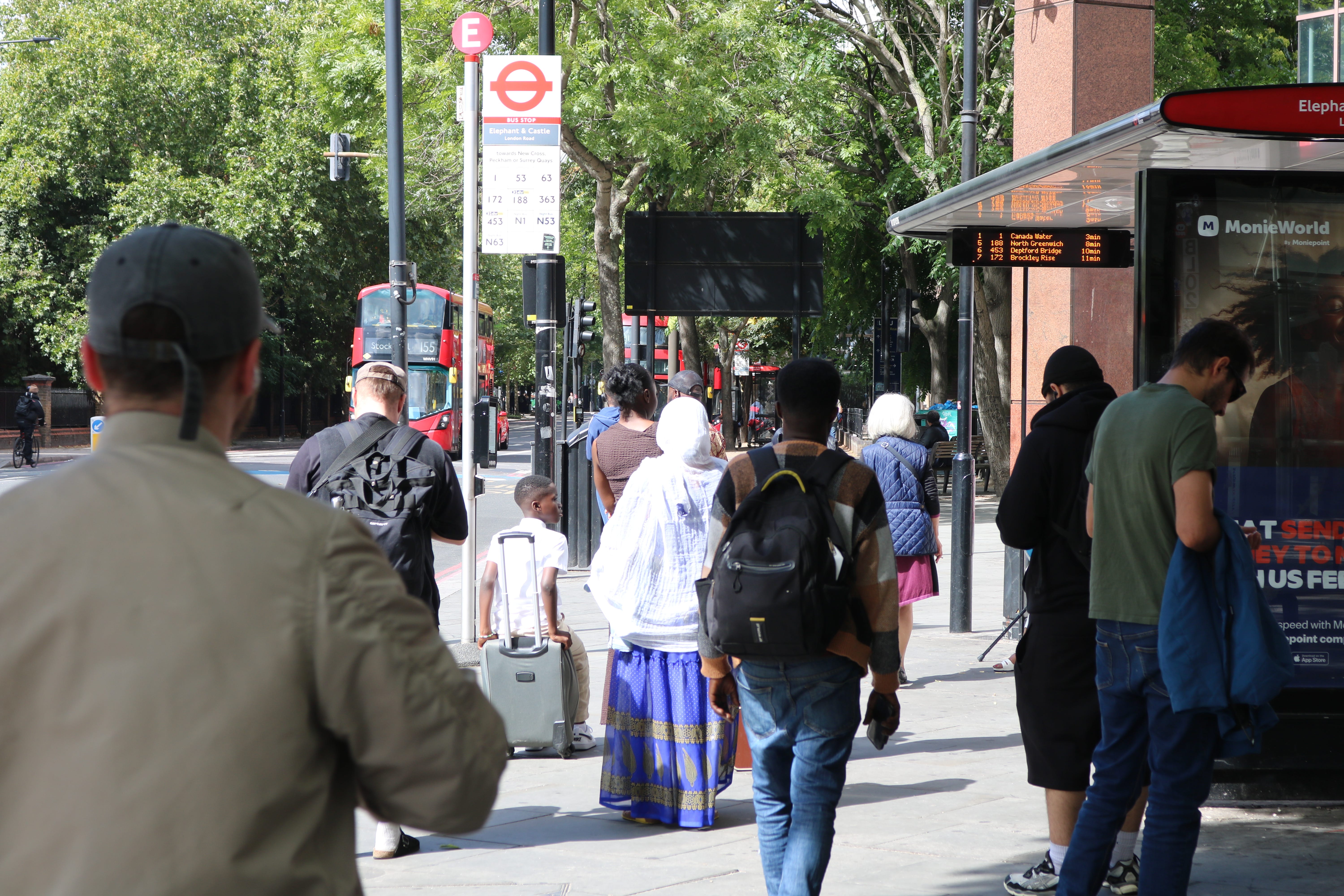
The use of e-paper, while power efficient, means the screens aren’t illuminated and so if it’s night and you don’t have your phone as a light, you’re going to struggle. On the tablets, the screen lights up when you press the buttons at night (or at least I think it does - I didn’t try them in the dark), but each time it does this, it’s one step closer to a dead battery.
What makes the current Countdown good
At present, where Countdown is situated there is a shelter and there is mains power. Therefore there’s no reason not to have a big display that’s bright and can be read from a distance and at night.
And what bugs me is that each prototype’s deployment is followed by a flurry of media attention cued by a TfL press release, usually highlighting tech gimmickry and being all “look what this can do!”. But what seems to be missed is that Countdown in its current form (in hardware terms at least…) is actually quite good.
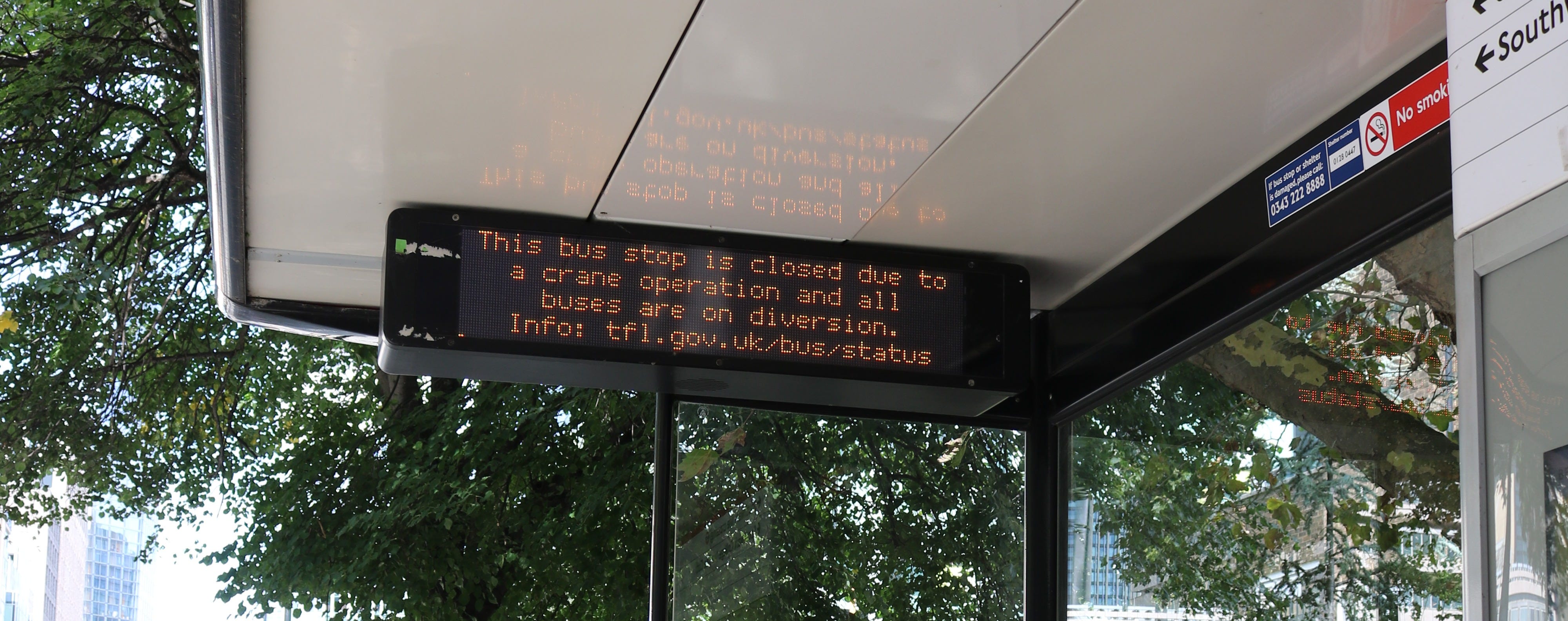
I’m a strong advocate for single-colour LED matrix screens - they’re big, easy to read and high contrast. They may not be able to display fancy graphics or animations but here the purpose is to display bus arrivals as text. The screens can be mounted high up, and in the direction the bus is coming from - something you can’t do with a tablet-sized device - and they last for literal decades.
In closing
It’s disappointing that we’re yet to see a prototype for Countdown that lives up to the core strengths of the current system.
What’s telling is that in TfL’s Bus Action Plan, Countdown is written about in the past tense, as if it’s already consigned to history (see page 41), and that was from 2022. The document praises those tiny flag sign displays and seems to frame them as an “enhancement” to the customer experience. At stops without Countdown, maybe. As a replacement where it already exists? Absolutely not.
If TfL want to make an e-paper display for stops without shelters or mains power, fine - make it a second product, a ‘Countdown lite’, and roll it out. (Have I mentioned the e-tablet is brilliant? Do that!) Just don’t mistake that for replacing Countdown. Any solution that ignores the current system’s strengths is a downgrade dressed up as progress.
Debrief:
This was the third and final piece in a series of posts looking at Countdown. I could easily have gone further on certain parts of this - particularly comparing the performance of each of my concept designs in ‘A better approach?’ at different stops with different characteristics (service frequency, number of routes, etc.) - but I think that would’ve strayed into optimisation weeds, beyond the scope of discussing Countdown itself.
I understand that TfL have awarded a contract for “London’s largest RTPI upgrade” to Australian firm Vix Technology - the company that manufactures both prototypes currently out there on the network. They’re due to start a pilot this winter, so once the ball is rolling I may have to write another post. (I’ll probably write one just gushing about the tablet.) But I’m crossing my fingers they come up with a third product that can stand shoulder to shoulder with the venerable Countdown we know and love.
Previous posts:

