

Sign language on screens: useful?
A look at whether signing train departures in BSL makes sense.

tl;dr: Using screens to display signing of train departures is more useful than it might first seem, but it’s not clear if it really goes far enough.
As an upfront disclaimer, I admit to approaching this from an uninformed position, but given it relates to an information system, I figured it deserved proper scrutiny.
The idea
I’ve now seen, in two separate stations (London Waterloo and Liverpool Street), a random standalone display showing video of a person signing information about upcoming train departures, one at a time, in British Sign Language or BSL.
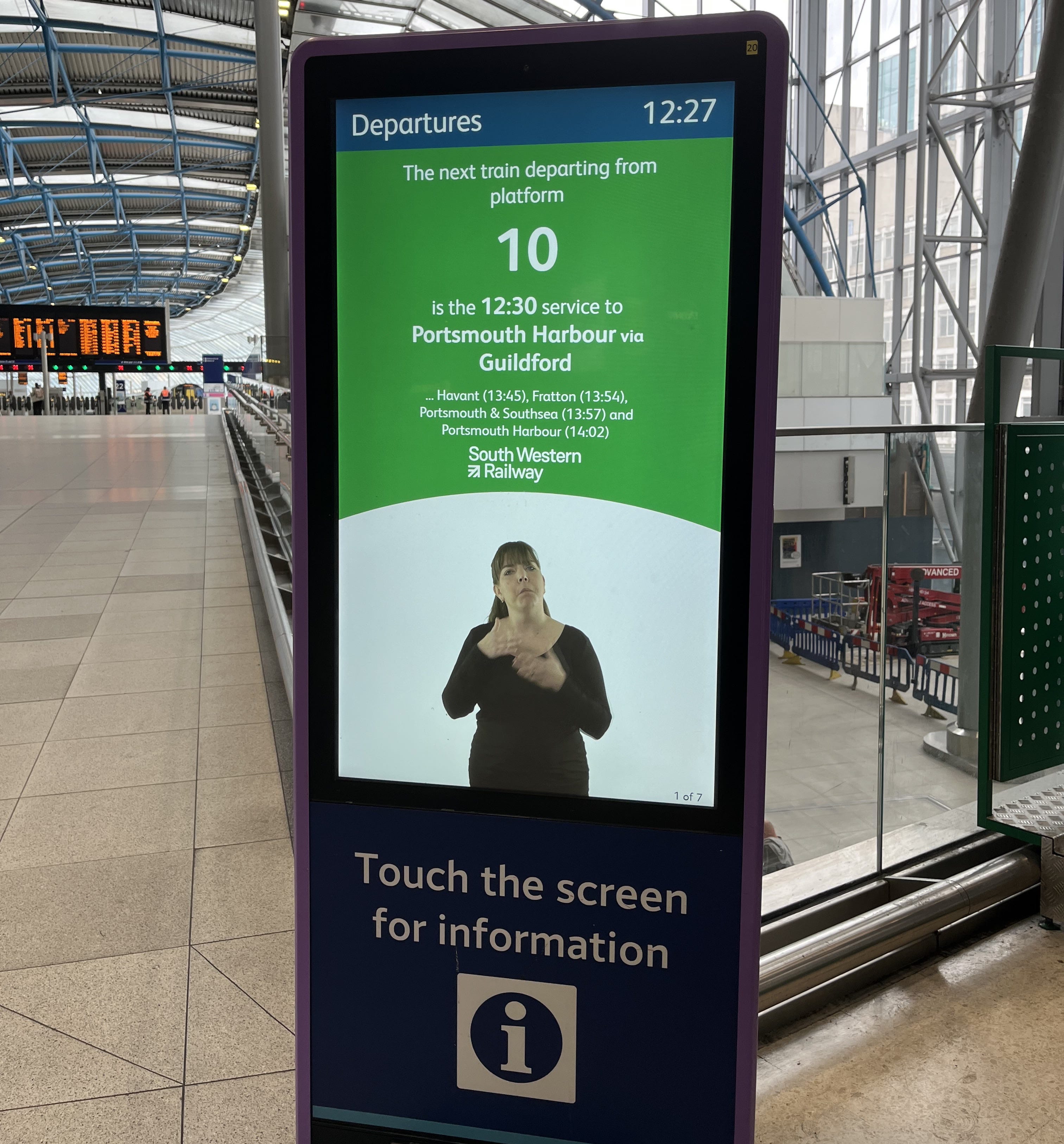
Accompanying the signer is the information they’re conveying, but in text - “The next train departing from platform 10 is the 12:30 service to Portsmouth Harbour via Guildford” followed by a list of calling points and the operator’s logo.
And that got me thinking.
Who is this for?
My initial (and obviously uninformed) interpretation was “this makes no sense”.
To my mind, signing was primarily a means of communication for the deaf (Deaf?) or hard-of-hearing. And generally speaking, to be able to use sign language, you would have to be able to see. And so in my ignorance, it followed that you would be able to just look at the train departure boards which have all of the information for all of the trains, without being able to hear the announcements.
That would make these screens seem silly, and of course that was my initial reaction. But there must be a better reason than that, surely?
I’m no linguist, but even still perhaps it was naïve of me to assume that those using signing as a means of communication were doing so as a substitute for speaking or listening to English. In the 2021 census of England & Wales, BSL was the main/preferred language of 22,000 people, who if they use English at all, do so as an additional language, and that reframes things in my mind.
This is fascinating to me - we learn our mother tongue by listening and speaking at a young age, and then learn how to read and write the same words we already know after. This means that a person who is deaf, hard-of-hearing or otherwise dependent on sign language from birth (or at least a very early age) has an entirely different internal experience of communication and language. Imagine learning to read and write without the context of already knowing how to listen and speak.
It’s too easy to look at sign language as a ‘code’ for English, much in the same way that the bunches of letters we write and the various sounds we make to one another are, but the fact of the matter is it has no connection at all.
It follows that there are some people who communicate by signing alone and have limited or even no English skills, meaning text and writing (on a departure board, in this case) isn’t as accessible as it might first appear. There can be many reasons why this might be the case - a lack of access to specialist communication support in schools, for instance, or it may even be down to personal preference.
These are the people - from what I can tell - that these screens are trying to assist. And with that in mind, I think it’s kinda brilliant.
Is this a good way to do it?
If we’re trying to make the railway and public transport more accessible to this particular group of people, is this the best way that we can do it?
In the stations where I’ve seen these screens - both managed by Network Rail - there are a lot of terminal platforms (19 and 24, to be specific), and that means they’re quite big places. I’ve seen one screen in either, and as it’s portable it was placed in a fairly obscure position - you would have to know where it was or be looking for it to be able to make use of it.
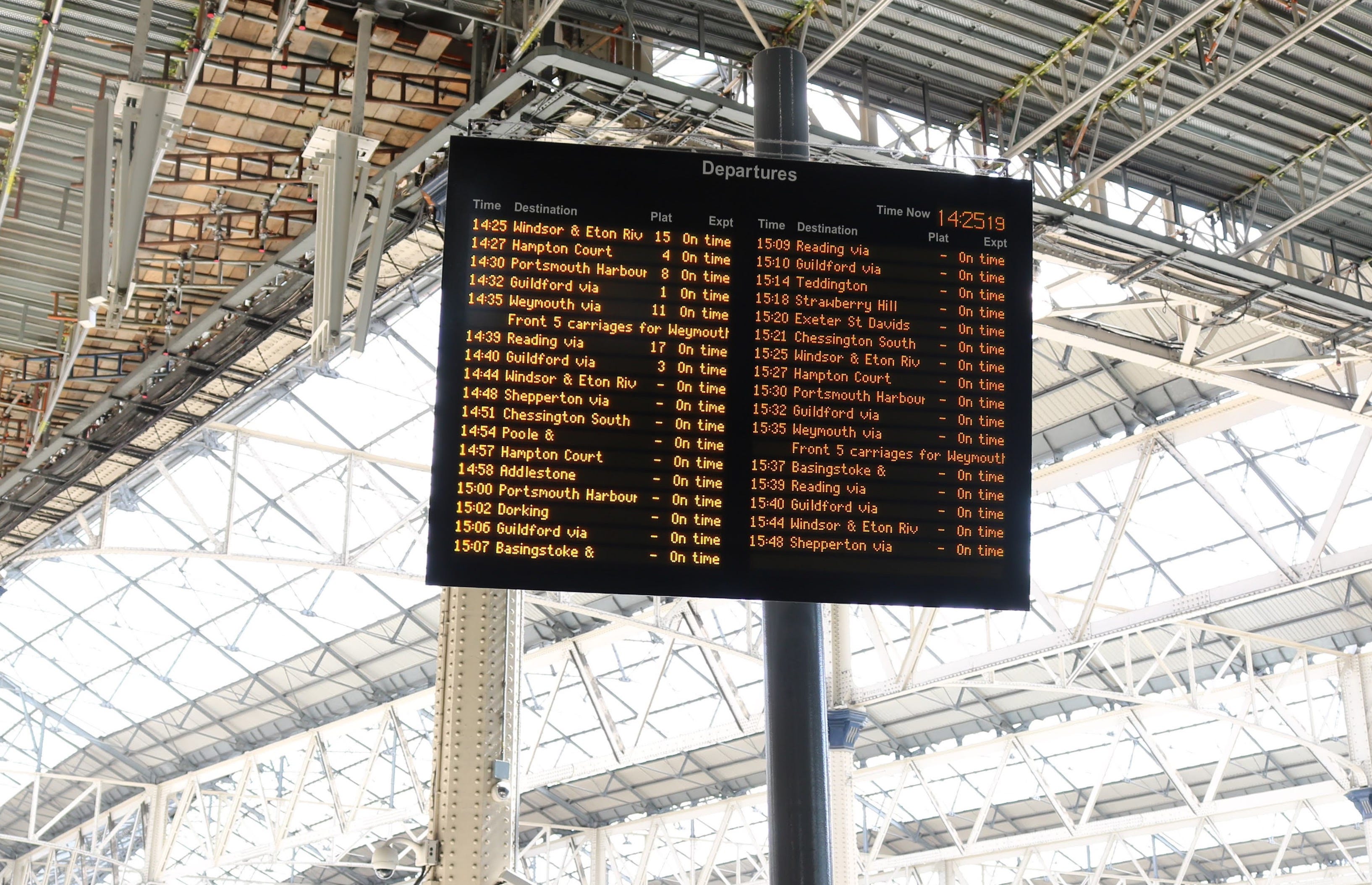
The information has to be presented in a linear fashion - one train at a time in sequence - and so it’s inherently low density. This means that getting the information for a specific train takes time. Relative to a bank of departure screens that can be meerkat-ed up at and scanned to find a desired train, it doesn’t really compare.
Only when we consider the signed videos in the mould of announcements does it start to make more sense. What is being signed is what would be announced. So it’s not completely crazy. It’s information at the density you would expect to hear. Would I be able to catch a train in a station if there were no departure boards but only announcements? I could manage, but I’m pretty sure it’d be frustrating.
And then what?
This is the question my mind jumps to.
These passengers arrive at the station and - assuming they find the screen wherever it is - can eventually find out which train they’re going to take, when it’s leaving and from which platform. How do they buy a ticket? Are there staff that are trained in BSL working in the station that are available to assist at ticket machines or ticket offices (where they’re still in existence) or even at the barriers? Is there a BSL-trained member of staff on board every train? What about at the other end, or if they need to change trains?
I can’t help but wonder how this functions as a coherent system overall. This isn’t to say that making parts of the journey more accessible - in this case the experience of finding your train in one station - is a bad thing. I just question what use it is if the rest of their journey is not going to live up to the same standards. If we’re to support these people, it needs a whole-system approach - you have to go all in.
In that sense, do these screens really help, or are they just a token gesture?
Not at-a-glance
The biggest weakness of these screens - and it shows - is that there’s no way to have ‘at-a-glance’ information. Instead, information just drips out, one train at a time. At busy stations with lots of departures, it’s going to take a while and feel pretty inconvenient. This places these passengers at a disadvantage to everyone else, and means they could potentially even miss their train as a result.
What’s the next best thing to ‘at-a-glance’ information? There needs to be some way that passengers can request information about a specific train or the next train to a destination. Would it be simply better to ensure that there’s a BSL-trained staff member on hand to provide this information? How are we going to ensure that there is always one such person on shift? What if they’re sick? The screen doesn’t get sick (in theory…), even if it takes a while to tell you what you want.
It needs interactivity. Let’s assume a touchscreen UI is out of the window because that would probably involve text. Could some sort of video sign interpreting system be used so that passengers could request information in BSL, with pre-recorded or computer-generated virtual signers that respond? I don’t even have to check whether such technology exists in some form, it definitely does.
Critical thoughts
I like the intention behind these screens. But is the data there to support their existence? Census data showed there were 22,000 with BSL as their main language, representing 0.04% of the population. Of these people, how many don’t have basic English as an additional language - that is, in terms of reading and writing? This is a figure we don’t know, and regrettably might never know, but certainly it will be less than 22,000.
Are these people travelling on our railway network independently? I ask that non-rhetorically - I don’t know, and I’m not sure Network Rail does either, given there isn’t really any data. Let’s assume Network Rail are the only people using these screens at their stations - that’s 20 stations of over 2,500. It turns out that LNER and TransPennine Express are using similar technology at their stations, c2c are running trials, and Northern are introducing it on some trains.
And have the targeted users actually asked for these screens, or was this a solution thought up by someone imagining what would help them without their involvement? Have they responded positively to their deployment? I ask that not to be cynical - I’m just trying to think critically and with as open a mind as I can muster.
Conclusion
This piece has been one that raises more questions than it answers, frankly - and I won’t lie that I don’t really have a conclusion to draw, just a list of things I’d like to know.
I could have come in here snarky and ignoring inconvenient facts to make a pointed argument as though I’m a Daily Mail columnist, but alas I have no narrative to push (other than “information systems must be good”, of course).
You’ll note I haven’t made this about cost at any point and don’t intend to - a handful of screens will be a drop in the ocean of Network Rail’s finances, so I don’t think it’s really a concern.
Is it wasteful? I don’t think so.
Should this exist? Probably, but perhaps not in this form.
What this has done is opened up my eyes - just a little bit - to the lives of a group of people in circumstances I’d never given a particularly deep amount of thought to.
I’m also now interested in learning BSL - it feels worth trying to understand properly.